
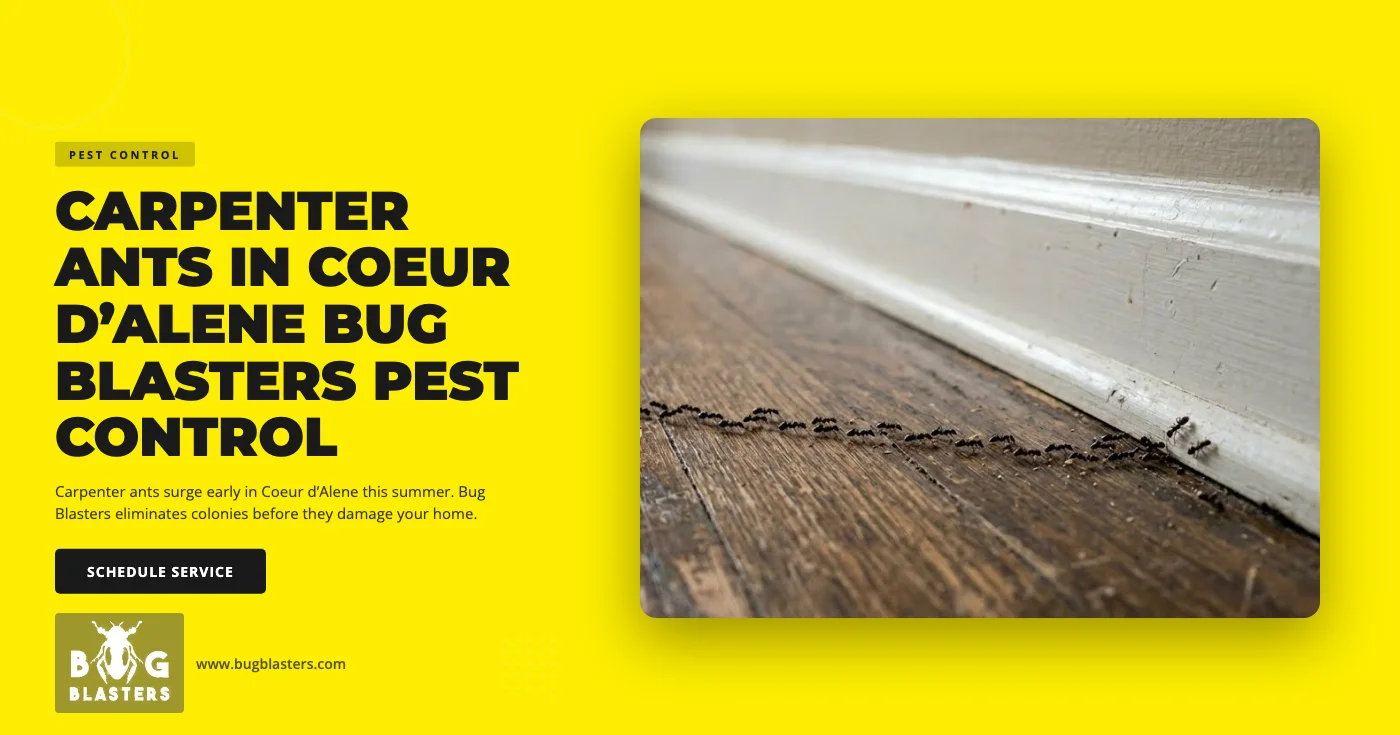
If you've started seeing large black ants in or around your home this summer, you're not imagining it — and you're not alone. Carpenter ants are among the most common and most misunderstood pest problems in Coeur d'Alene, Idaho, and each year the warm season seems to start earlier than the last. What many homeowners mistake for a minor nuisance is often the visible edge of a much larger colony that has been quietly establishing itself in your home's structural wood for months.
At Bug Blasters, we specialize in professional ant control in Coeur d'Alene, ID and throughout the surrounding region. We handle ant infestations for homeowners across Kootenai County every summer, and we understand exactly why carpenter ants are so prevalent here and what it takes to eliminate them. This guide covers identification, warning signs, and what a professional elimination program actually involves — so you can make an informed decision about protecting your home.
Why Coeur d'Alene, ID Has a Major Carpenter Ant Problem Every Summer
Coeur d'Alene's landscape — dense pine and cedar forests, abundant moisture from Lake Coeur d'Alene and seasonal rainfall, and a significant inventory of older wood-frame homes — creates almost ideal habitat for carpenter ants. To understand why they're such a persistent problem here, it helps to understand what carpenter ants are actually doing in your home.
Unlike termites, carpenter ants don't eat wood. They excavate it. They carve out galleries and tunnels through moist, soft wood to create nesting chambers for their colony. This makes them particularly dangerous to structures because the damage they cause is structural — hollowed-out beams, joists, framing, and siding that are weakened from the inside without any visible external sign until the damage is severe.
Coeur d'Alene's climate is a major contributing factor. The region's wet springs leave wood siding, fascia boards, and structural framing with elevated moisture content well into summer — exactly what carpenter ants are looking for. Any wood that has been compromised by prior water intrusion, small leaks, or inadequate drainage is especially vulnerable, because moisture-damaged wood is softer and far easier to excavate than dry wood.
The dense forests surrounding the city also mean there's a massive reservoir of natural carpenter ant habitat adjacent to residential areas. Colonies establish in fallen trees, stumps, and dead wood throughout the landscape — and as those colonies mature and expand, they send out scouts into nearby structures looking for new nesting sites. The ant control coeur d alene id challenge isn't just eliminating the ants you can see; it's addressing the conditions that make your home attractive to colonies coming from the surrounding forest.
How to Identify Carpenter Ants vs. Other Common Idaho Ants
Not all ants are the same, and the treatment for carpenter ants is very different from the approach for pavement ants, odorous house ants, or other common Idaho species. Misidentifying the pest leads to ineffective treatment — which is why correct identification is the first step in any ant control program.
Carpenter Ants (Camponotus spp.)
Carpenter ants are large — workers typically range from ¼ to ½ inch, with queens and reproductives (swarmers) reaching up to ¾ inch. They're usually black or dark reddish-black, though bi-colored black and red workers occur in some species common to Idaho. They have a single node between the thorax and abdomen, a rounded thorax profile when viewed from the side, and relatively large, prominent mandibles. When workers forage inside a home, they're often visible moving in lines along baseboards, under door frames, or around windows — particularly in the evening.
Odorous House Ants
Much smaller than carpenter ants (around ⅛ inch), odorous house ants are dark brown to black and get their name from the distinctive coconut or rancid butter smell they emit when crushed. They don't damage wood — they're primarily foraging for food sources in kitchens and pantries. A line of tiny dark ants in the kitchen is almost always odorous house ants rather than carpenter ants.
Pavement Ants
About ⅛ inch long and dark brown, pavement ants are commonly found nesting under concrete slabs, driveways, and foundations. They create characteristic soil mounds along cracks in pavement and entry points at the base of walls. Like odorous house ants, they don't damage structural wood.
Moisture Ants
Often confused with carpenter ants because they're associated with wood, moisture ants are smaller (about ¼ inch) and typically yellow-brown to light brown. They're a sign of a moisture problem — they colonize wood that's already rotting due to water damage. Finding moisture ants is important because it indicates a water intrusion issue that needs to be corrected regardless of the pest treatment.
If you're seeing large (¼ inch or bigger), dark, single-node ants around your home — particularly in wood trim, near windows, in crawl spaces, or around plumbing — the probability of carpenter ants is high and warrants a professional inspection.
Signs of a Carpenter Ant Infestation in Your Coeur d'Alene Home
Carpenter ants often establish themselves in structural wood for months before homeowners notice them. Knowing the warning signs lets you catch the problem before significant damage occurs:
Sawdust-Like Material (Frass)
The most distinctive sign of carpenter ant activity is frass — a mixture of coarse wood shavings, insect body parts, and other debris that the ants push out of their galleries as they excavate. Unlike termite frass, which is uniform pellets, carpenter ant frass is irregular and looks like rough sawdust or wood shavings. Finding frass below a wall void, in a window sill area, or in a crawl space is a strong indicator of active excavation nearby.
Large Ants Inside the Home, Particularly at Night
Carpenter ants are most active after dark. If you're seeing large black ants inside your home in the evening — especially in bathrooms, kitchens, or near window frames — they're almost certainly foraging workers from a colony that may be nesting in or near the structure. A single ant doesn't constitute a colony, but consistent sightings of multiple individuals warrants investigation.
Rustling Sounds in Walls or Wood
In an established infestation, the excavation activity of a large colony can sometimes be heard — a faint rustling or crackling sound from inside a wall void or structural member. This is more commonly noticed in quiet nighttime conditions. If you hear unexplained sounds in your walls that don't correspond to plumbing or HVAC activity, carpenter ants are worth considering.
Winged Ants (Swarmers) Inside the Home
Mature carpenter ant colonies produce winged reproductives — swarmers — that emerge in late spring or early summer to find new nest sites. If you're seeing winged ants inside your home, that's a strong indicator of an established colony somewhere in the structure. Swarmers inside mean the colony is already resident — they're not scouts looking for a place to start, they're offspring of a mature colony already nesting nearby.
Soft, Hollow-Sounding Wood
In areas where infestation is suspected, tapping on wood with a screwdriver handle produces a noticeably hollow sound when galleries are present. This is most useful for checking fascia boards, window frames, door frames, and any structural wood that has been exposed to moisture.
DIY Ant Control vs. Professional Treatment — What Actually Works
When homeowners discover carpenter ants in their home, the first instinct is often to reach for a store-bought spray or bait. Understanding why over-the-counter products typically fail for carpenter ant infestations — and what professional treatment actually does differently — is important for making the right decision.
Why DIY Sprays Usually Fail
Most consumer-grade ant sprays are contact killers — they eliminate the ants they physically touch, but they don't penetrate to the colony. Carpenter ant colonies typically nest inside wood voids, wall cavities, or sub-floor spaces where spray never reaches. Killing foraging workers doesn't eliminate the queen or the workers inside the nest. In fact, heavy contact insecticide use can cause a colony to "bud" — splitting into multiple satellite colonies at new locations, effectively spreading the infestation.
Why Store-Bought Baits Often Don't Work
Ant baits work by providing a toxic food source that foragers carry back to the colony. Carpenter ants are omnivores with a preference for proteins and sweets, but they're also selective — and they're not always receptive to the formulations available in consumer bait products. Professional-grade baits use formulations calibrated for carpenter ant preferences and are deployed based on observed foraging patterns, making them significantly more effective than generalized consumer products.
What Professional Treatment Does
A professional carpenter ant treatment combines direct nest treatment (injecting insecticide into identified nest voids), perimeter treatment to interrupt foraging trails and prevent re-entry, and bait placement based on colony behavior. The goal isn't just to kill the visible workers — it's to deliver lethal product directly to the nest, reaching the queen and the interior colony population that consumer products never contact.
For most established carpenter ant infestations in Coeur d'Alene homes, a professional treatment is the only approach that reliably resolves the problem rather than managing the symptoms.
How Bug Blasters Eliminates Ant Colonies at the Source
At Bug Blasters, our approach to carpenter ant treatment coeur d alene idaho is systematic and targeted — not a generic perimeter spray and hope for the best. Here's how a professional ant control program works:
Thorough Inspection
We start with a detailed inspection of the structure and property to identify active colonies, potential satellite colonies, foraging trails, and conducive conditions (moisture damage, wood-to-soil contact, excessive mulch) that are contributing to the problem. The inspection guides every aspect of the treatment plan.
Direct Nest Treatment
Where nesting voids are identified — in wall cavities, under siding, in fascia boards, or in the crawl space — we inject insecticide directly into the nest zone. This delivers lethal material to the colony interior and is the most critical component of effective elimination.
Perimeter and Entry Point Treatment
We treat the structural perimeter, foundation, and identified entry points to eliminate foraging trails and create a barrier that prevents outdoor colonies from re-establishing access to the structure. This includes addressing areas where wood contacts soil and other conducive conditions that give ants easy access.
Bait Deployment
Professional carpenter ant baits are placed at identified foraging locations to supplement direct treatment and reach workers that weren't in contact with the direct application. Baits continue working over days and weeks as foragers carry them back to the colony.
Follow-Up and Documentation
Established carpenter ant infestations rarely resolve with a single treatment. We schedule follow-up visits to assess treatment effectiveness, address any surviving colony activity, and verify that conducive conditions have been corrected. We document activity at each visit so you have a clear record of progress.
Preventing Ant Reinfestation Around Your Coeur d'Alene Property
Eliminating an active carpenter ant infestation is only half the battle. Preventing re-entry requires addressing the conditions that made your home attractive in the first place. Here are the most important preventive steps for Coeur d'Alene homeowners:
- Eliminate wood-to-soil contact. Any wood framing, siding, deck posts, or structural members that directly contact soil are vulnerable to both moisture infiltration and carpenter ant access. Maintaining a gap between wood and soil is one of the most effective long-term prevention measures.
- Remove decaying wood from the property. Stumps, fallen logs, old railroad ties, and rotting wood debris near your home provide natural habitat for carpenter ants. Removing these reduces the colony population in your immediate environment and eliminates the satellite-nest launching points closest to your structure.
- Address moisture problems promptly. Leaking gutters, roof drainage issues, inadequate ventilation in crawl spaces, and plumbing leaks all create the moist wood conditions that carpenter ants prefer for excavation. Keeping structural wood dry makes your home significantly less attractive.
- Keep firewood away from the structure. Firewood stacked against the house or in a garage is a common entry point for carpenter ants. Store firewood at least 20 feet from the structure and off the ground, and only bring it inside as needed.
- Seal potential entry points. Gaps around windows, door frames, utility penetrations, and where pipes or wires enter the structure provide access for foraging ants. Caulk and seal these points to reduce entry opportunities.
- Schedule annual inspections during peak season. In a region with as much natural carpenter ant pressure as Coeur d'Alene, annual professional inspections during the spring or early summer allow new colony activity to be caught and addressed before it causes significant damage.
Carpenter ants are a manageable problem when addressed correctly — but the key word is "correctly." If you're seeing large dark ants in your home this summer, don't wait and hope the problem resolves on its own. Contact Bug Blasters for professional ant control in Coeur d'Alene, ID. We'll inspect your property, identify the extent of the infestation, and build a treatment program that eliminates the colony at the source — protecting your home before structural damage becomes a problem.