
Summer in Sandpoint, ID brings long evenings on Lake Pend Oreille, weekend trips across the Northwest, and visitors filling every short-term rental between First Avenue and Schweitzer. It is also the season when bed bugs travel hardest. They hitch rides in luggage, settle into hotel mattresses and rental couches, and follow guests home from cities where infestations are far more common than they are in North Idaho. By August our team starts taking calls from Sandpoint homeowners who picked up an unwanted souvenir from a single weekend trip — and by then the infestation is rarely small.
At Bug Blasters we serve Sandpoint along with Post Falls, Coeur d'Alene, Hayden, and the rest of North Idaho. The good news: bed bug prevention in Sandpoint, ID is genuinely doable for any traveler willing to spend five minutes inspecting a hotel room and another five unpacking the right way at home. This guide covers why summer is peak hitchhiking season, how to spot bed bugs in luggage and hotels, what to do the moment you get home, and how to recognize an early infestation.
Why Bed Bug Encounters Spike for Sandpoint Travelers in Summer
North Idaho's summer travel rhythm is the biggest driver of bed bug encounters for Sandpoint households. From late May through early September, our region empties out toward Spokane, Boise, and Seattle while Schweitzer and the lake pull in tourists. Every short-term lodging turnover is an opportunity for bed bugs to hop from one set of luggage to the next. Climate barely matters to bed bugs — they live indoors on people and in furniture. Movement matters, and summer is when North Idaho moves the most.
The U.S. Environmental Protection Agency notes that bed bugs are excellent hitchhikers and travel from infested sites on furniture, bedding, luggage, boxes, and clothing (EPA: Tips for Travel). Our Sandpoint call volume reliably climbs in late July and peaks in September. Vacation rentals and Airbnb-style stays often carry higher exposure than well-managed chain hotels — they turn over weekly, are cleaned by different crews, and rarely have formal inspection protocols. Cabins and lodge rooms around the lake are not immune. Inspect every room you sleep in, every time.
How Bed Bugs Hitchhike: Luggage, Clothing, and Souvenirs
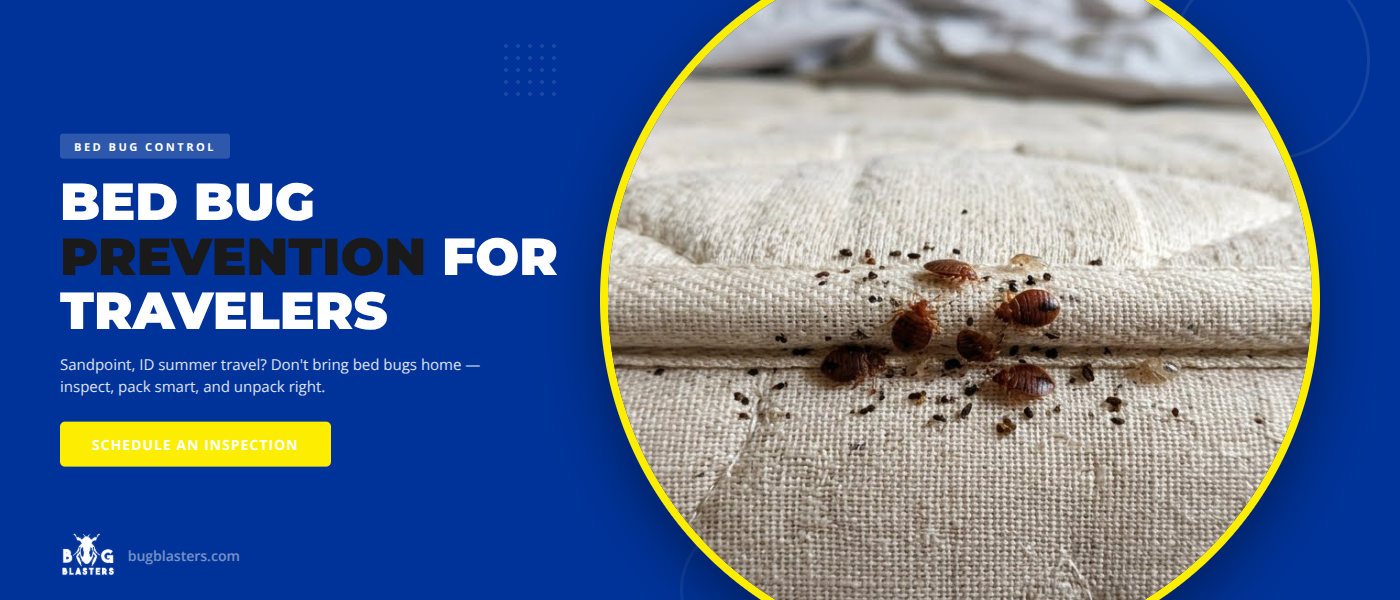
Bed bugs are flat, oval, reddish-brown insects about the size of an apple seed when fully grown. Nymphs are smaller and lighter; eggs are around one millimeter and pale. They cannot fly or jump — they crawl. On the road they hide in places that stay still with small dark crevices: hotel mattress seams, the underside of a luggage rack, the gap between a headboard and the wall, the inside corner of a nightstand drawer. When a guest leaves a suitcase open on the bed or floor overnight, bed bugs crawl in, settle into the seams and zipper tracks, and ride home undisturbed. Backpacks, jackets draped over chairs, and shoes near the bed are all viable rides.
Souvenirs and secondhand purchases are another vector. Used books, antiques, thrift-store clothing, and any upholstered item picked up on a road trip can carry bed bugs or eggs. We have responded to Sandpoint infestations that traced back to a single antique chair brought home from a weekend in Spokane. The reassuring part: bed bugs cannot survive a full cycle in a hot dryer, and a single hitchhiker caught at the door rarely becomes an infestation. The goal of a travel routine is to catch them there.
How to Inspect a Hotel Room in 5 Minutes Before You Unpack
Before any luggage touches the bed, couch, or carpet, do a quick five-minute inspection. Set your bag on the hard tile floor of the bathroom — the least likely surface in the room to harbor bed bugs — and start the walk-through.
1. Pull back the bedding and inspect the mattress seams
Strip the sheets to the bare mattress. Use your phone flashlight on the piping, seams, and tags — especially at the head of the bed. Look for live bugs, translucent shed skins, tiny pale eggs, or rust-colored and dark pepper-like spots. Those spots are bed bug droppings, the single most reliable sign of an active population.
2. Check the box spring and bed frame
Lift the mattress corner and shine the light along the box spring's piping and fabric seams. Inspect the wooden joints of the bed frame, screw holes, and slats — bed bugs love unfinished wood and tight joints.
3. Look behind the headboard and on the wall
Peek behind a wall-mounted headboard where the bracket meets the wall. Check outlet plates and wall texture immediately around the bed. Dark specks on the wall near the bed are a red flag.
4. Inspect the luggage rack and upholstered furniture
Check the seams and underside of the luggage rack and any chair, couch, or curtain near the bed. Soft furniture is the second-most-common hiding spot.
5. Decide before you unpack
If the room is clean, store your zipped suitcase on the luggage rack — never on the bed or floor. If you find anything suspicious, do not unpack. Take photos, notify the front desk, and ask for a new room in a different part of the building, or change hotels. Adjacent rooms often do not help — bed bugs spread through walls and shared electrical conduits.
What to Do With Your Luggage and Clothes When You Get Back to Sandpoint
The drive home is your last good chance to keep bed bugs out of the house. Handle luggage at the door instead of carrying it straight to the bedroom. The routine below takes about twenty minutes and dramatically lowers the risk of an infestation taking hold.
- Unpack in the garage or on a hard surface outside. Avoid carpet and upholstered furniture; a laundry-room tile floor is the next-best option.
- Run all clothing through a hot dryer for at least 30 minutes. Sustained heat kills every life stage, including eggs. Washing alone is not reliable — heat is what does the work.
- Treat clean clothes the same as dirty. If it traveled with you, it goes through the dryer.
- Inspect the suitcase thoroughly. Use a flashlight on every seam, zipper track, wheel housing, and internal pocket. Vacuum the bag inside and out, then empty the canister into a sealed bag and into the outdoor trash.
- Store luggage away from bedrooms. Garage, basement, or a sealed plastic bin between trips — never under the bed or in a bedroom closet.
Early Warning Signs of a Bed Bug Infestation in Your Sandpoint Home
Even with a careful routine, misses happen. The next layer of protection is recognizing an infestation in its first weeks, when treatment is fastest and least disruptive. The CDC notes that physical evidence is far more reliable than relying on bites alone, because bites can mimic mosquito reactions, hives, or eczema and many people show no reaction at all (CDC: About Bed Bugs). Watch for the following in the weeks after summer travel:
- Rust-colored or dark pepper-like spots on sheets, mattress seams, or box spring piping. The most reliable early sign — check first thing in the morning before making the bed.
- Pale, translucent shed skins in mattress seams or along baseboards near the bed. Nymphs molt five times before adulthood, and the cast skins accumulate.
- Tiny white-yellow eggs about one millimeter, often in clusters wedged into seams, wood joints, or cracks within a few inches of where you sleep.
- A faint sweet, musty odor in the bedroom that was not there before. Heavy infestations have a distinct smell some people describe as overripe berries.
- Bites in lines or clusters on exposed skin overnight. Bites alone are not diagnostic, but combined with the signs above they are a strong indicator.
If any of these show up four to eight weeks after a trip, do not wait. Bed bug populations double quickly, and the gap between a one-room treatment and a whole-home treatment is often just a few weeks of delay.
Why Professional Bed Bug Treatment Beats DIY in North Idaho
We understand the impulse to handle a small problem yourself. Bed bugs are a different category. They have evolved resistance to over-the-counter pyrethroid sprays, hide in places homeowners cannot easily reach, and reproduce fast enough that an incomplete treatment almost always grows back worse.
The most common DIY mistake we see in Sandpoint homes is partial coverage. A homeowner sprays the mattress and bed frame; bed bugs retreat into the box spring, wall outlets, baseboards, and carpet edge, and weeks later the population is back at full strength in places the spray never touched. Foggers and bug bombs scatter the bugs deeper rather than killing them, often spreading the infestation from one room to several. Professional treatment combines targeted inspection, whole-room heat that eliminates every life stage in one visit, professional-grade residuals applied directly into harborage zones, and scheduled follow-ups to catch any eggs that hatch after the first treatment. For the broader pest pressure that often accompanies bed bug calls, our recurring general pest control in Sandpoint service keeps the perimeter under control while bed bug-specific treatment handles the indoor population.
When to Call a Sandpoint, ID Bed Bug Exterminator
The best time to call us is the moment you find physical evidence — live bugs, fresh dark spots on bedding, or shed skins in mattress seams. Waiting almost always makes the treatment harder. Contact our team for professional bed bug extermination in Sandpoint, ID when you notice any of the following:
- Confirmed bed bug evidence in any bedroom — live bugs, eggs, or characteristic dark stains on the mattress or sheets.
- Recurring bites on multiple household members in lines or clusters after sleep.
- A recent trip followed by any of the warning signs above — early intervention is dramatically more effective than waiting.
- Any sighting in a multi-unit building — apartments, duplexes, and short-term rentals require coordinated treatment because bed bugs move through shared walls.
- Failed DIY attempts — if you have already sprayed and the problem is back, professional treatment is the next step.
Our bed bug program starts with a thorough inspection, identifies every harborage zone, applies the right combination of heat and targeted residual treatment, and schedules follow-up visits to confirm the population is gone. We serve Sandpoint along with Post Falls, Coeur d'Alene, Hayden, Rathdrum, Spirit Lake, and Athol. Reach our team through our contact page to schedule an inspection or ask about a precautionary treatment after a trip. The earlier we get involved, the smaller the treatment.
Frequently Asked Questions About Bed Bug Prevention in Sandpoint, ID
How do I know if I brought bed bugs home from a hotel?
Watch for rust-colored spots on your sheets, pale shed skins in mattress seams, or unexplained bites in lines or clusters after sleep. Symptoms typically appear within two to six weeks of exposure. Inspect mattress seams and box spring piping with a flashlight first thing in the morning — evidence is easiest to spot then.
Can I just wash my clothes after a trip to kill bed bugs?
Washing alone is not reliable. The EPA specifies that high heat in a dryer for at least 30 minutes is what kills every life stage, including eggs. Run all travel clothing — clean and dirty alike — through a hot dryer cycle before putting anything away.
Does Bug Blasters serve Sandpoint, ID for bed bug control?
Yes. We provide bed bug extermination in Sandpoint, ID along with the rest of North Idaho. Reach our team through our contact page to schedule an inspection or ask about a precautionary treatment after travel.
Are your bed bug treatments designed with families in mind?
Yes. Our technicians follow all label instructions and application protocols and walk through the products and methods used at the time of service. We also explain short-term steps to take around treated areas so your family and pets stay comfortable while the treatment does its work.