
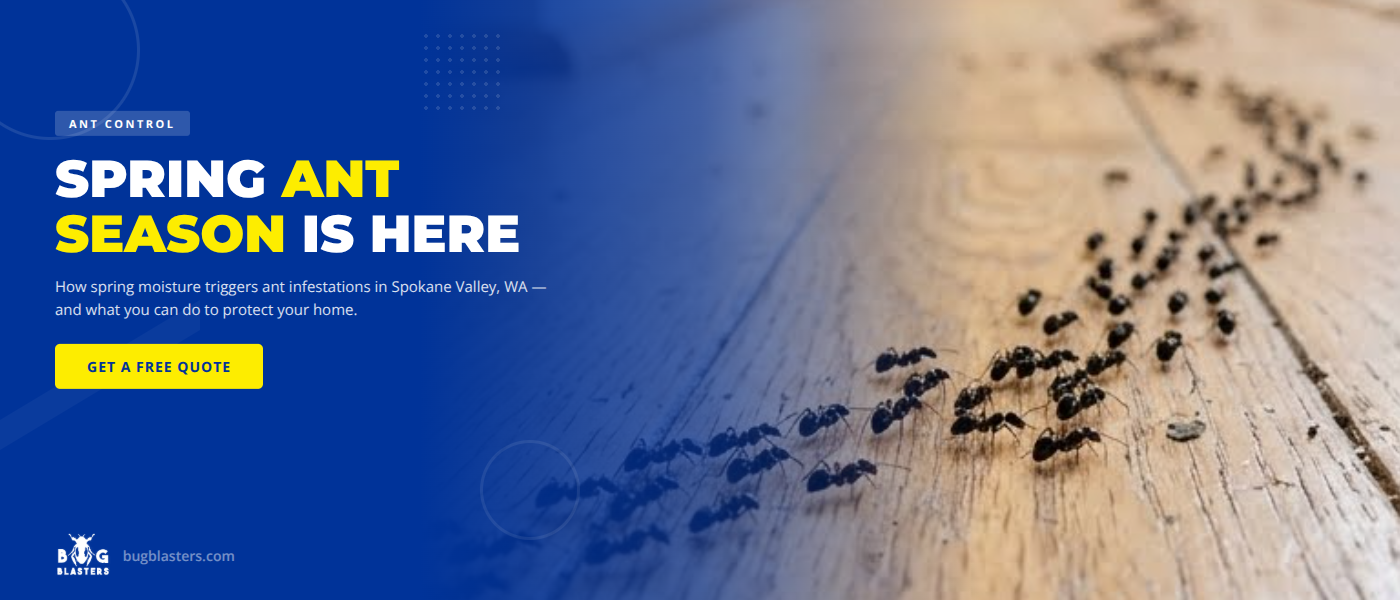
As the snow melts and temperatures begin to climb across Spokane Valley, WA, homeowners face a familiar springtime challenge: ants. Every year, the combination of warming soil and lingering moisture from winter snowmelt creates the perfect conditions for ant colonies to become active, expand, and start foraging for food inside our homes. At Bug Blasters, we have been helping families throughout the Inland Northwest deal with ant infestations for years, and spring is consistently our busiest season for ant-related calls. If you have noticed a trail of tiny invaders marching across your kitchen counter or discovered sawdust-like debris near your baseboards, you are not alone.
In this guide, we will explain why spring moisture triggers ant infestations in Spokane Valley, help you identify the most common ant species in our area, share practical prevention strategies, and explain how our professional ant control services can protect your home all season long. Whether you are dealing with a handful of scout ants or a full-scale invasion, we are here to help you reclaim your space.
Why Spring Moisture Drives Ant Infestations in Spokane Valley, WA
Understanding why ants become so active in spring requires a look at the unique climate conditions here in the Inland Northwest. During winter, ant colonies enter a dormant phase, retreating deep into the soil or into the wood structures of our homes where temperatures remain stable. When spring arrives and the ground begins to thaw, colonies wake up hungry and ready to expand.
The real catalyst is moisture. Spokane Valley experiences significant snowmelt between March and May, saturating soil around foundations, pooling in crawl spaces, and seeping into compromised wood. Ants, particularly carpenter ants, are drawn to moisture-damaged wood because it is softer and easier to excavate for nesting galleries. The Pacific Northwest climate, with its cool, damp springs, provides exactly the environment these insects thrive in.
Spring rain compounds the problem. As water accumulates around your foundation, it drives ground-nesting ants upward and inward, seeking drier conditions inside your home. Satellite colonies that may have been quietly established in your walls during winter begin sending out foragers as food demands increase. This is why so many Spokane Valley homeowners suddenly notice ants in kitchens, bathrooms, and laundry rooms during the first warm weeks of spring.
Common Ant Species in the Spokane Valley, WA Area
Not all ants pose the same level of threat to your property. Identifying which species you are dealing with is the first step toward effective control. Here are the most common ants we encounter in the Spokane Valley region.
Carpenter Ants are by far the most concerning ant species in our service area. The most common species in the Pacific Northwest is Camponotus modoc, a large black ant with reddish-brown legs that can measure up to half an inch in length. Unlike termites, carpenter ants do not eat wood. Instead, they hollow it out to create smooth, clean nesting galleries. Over time, this excavation can compromise structural beams, window frames, deck supports, and other critical components of your home. Carpenter ants prefer wood that has been softened by moisture, which is why spring is prime time for new infestations. Signs of carpenter ant activity include small piles of fine sawdust-like frass near baseboards or window sills, rustling sounds within walls, and the presence of large winged ants (swarmers) emerging indoors.
Pavement Ants are smaller, dark brown ants that typically nest in cracks in driveways, sidewalks, and foundation slabs. While they do not cause structural damage like carpenter ants, they are prolific invaders of kitchens and pantries. Pavement ants are attracted to sugary and greasy foods and can establish trails from their outdoor nests into your home through tiny cracks in the foundation or gaps around utility lines. You will often notice small mounds of displaced soil along the edges of pavement or near your foundation during spring.
Odorous House Ants are another frequent visitor in Spokane Valley homes. These small, dark brown to black ants earn their name from the unpleasant, rotten-coconut-like smell they produce when crushed. They form massive colonies with multiple queens, making them particularly difficult to control without professional help. Odorous house ants are opportunistic nesters and will readily move their colonies indoors when outdoor conditions become too wet, which happens frequently during our spring thaw.
Moisture Ants are less well known but common in the Pacific Northwest. These yellowish-brown ants are strongly associated with decaying, waterlogged wood. Finding moisture ants in your home often signals a more serious underlying issue, such as a leaking pipe, poor drainage, or deteriorating crawl space wood.
Warning Signs of an Ant Infestation in Your Home
Catching an ant problem early can save you thousands of dollars in structural repairs, particularly when carpenter ants are involved. Here are the key warning signs every Spokane Valley homeowner should watch for during spring.
The most obvious sign is seeing live ants inside your home, especially in kitchens, bathrooms, or near water sources. A few scout ants may not seem alarming, but they are the advance party for a much larger colony. If you are seeing ants consistently in the same areas, there is likely an established trail leading to a nearby nest.
Frass deposits are a telltale sign of carpenter ant activity. These small piles of wood shavings, often mixed with dead ant parts, accumulate beneath areas where carpenter ants are actively excavating. Check along baseboards, near window and door frames, in the attic, and around areas where moisture has been a problem.
Winged ants appearing indoors during spring indicate that a mature colony exists within or very close to your structure. These reproductive swarmers are produced by colonies that are at least three to five years old, meaning the infestation has been building for some time. Many homeowners mistake winged ants for termites, so proper identification is important.
Hollow-sounding wood, soft spots in flooring, and doors or windows that suddenly stick can all indicate structural damage from carpenter ant nesting. If you tap on wood and it sounds hollow, or if you can push a screwdriver into what should be solid wood, you may have an active carpenter ant gallery.
Spring Ant Prevention Tips for Spokane Valley Homeowners
Prevention is always more effective and less expensive than treatment. Here are the steps we recommend to reduce your risk of an ant infestation this spring.
Control moisture around your foundation. This is the single most important thing you can do. Make sure gutters are clean and directing water at least four to six feet away from your foundation. Grade the soil around your home so it slopes away from the structure. Repair any leaking outdoor faucets, and address standing water in your yard promptly. In your crawl space, ensure vapor barriers are intact and that ventilation is adequate.
Eliminate wood-to-soil contact. Carpenter ants use direct wood-to-soil connections as highways into your home. Check that siding, deck posts, porch supports, and fence attachments do not make direct contact with the ground. Store firewood at least twenty feet from your home and elevate it off the ground. Remove dead stumps, fallen branches, and decaying landscape timbers from your yard.
Seal entry points. Inspect your foundation, window frames, door frames, and utility penetrations for cracks and gaps. Even a tiny opening is enough for ants to exploit. Use silicone caulk to seal cracks in your foundation and around windows. Install or replace weatherstripping on exterior doors. Pay special attention to where plumbing, electrical, and HVAC lines enter your home.
Trim vegetation away from your home. Branches and shrubs that touch your siding or roof provide direct pathways for ants to enter. Maintain a clearance of at least twelve inches between landscaping and your exterior walls. This also improves air circulation and helps keep siding dry.
Keep interiors clean and dry. Wipe down counters promptly after food preparation. Store pantry items in sealed containers. Fix leaky faucets and pipes immediately. Use exhaust fans in bathrooms and kitchens to reduce humidity. Empty indoor trash regularly, especially containers with food waste.
Why DIY Ant Control Often Falls Short
We understand the temptation to tackle ant problems with store-bought sprays and baits. However, most over-the-counter products only address the ants you can see, which represent a tiny fraction of the colony. Spraying foraging ants with contact killers can actually make the problem worse by causing the colony to split and establish new nesting sites throughout your home, a process known as budding.
Carpenter ant colonies require targeted treatment that reaches the primary nest and any satellite colonies hidden deep within wall voids, attic spaces, or crawl space framing. Without professional-grade products and the expertise to locate nesting sites directly, DIY efforts typically provide only temporary relief while damage continues behind the scenes.
How Bug Blasters Handles Ant Infestations in Spokane Valley, WA
At Bug Blasters, we take a thorough, science-based approach to ant control that goes far beyond surface-level treatments. Our process begins with a detailed inspection of your property, both interior and exterior. We identify the ant species involved, locate active nesting sites, map foraging trails, and assess moisture conditions that may be contributing to the problem.
Based on our findings, we develop a customized treatment plan that targets the specific species and conditions present at your property. For carpenter ants, this often involves treating wall voids, attic spaces, and crawl space areas where nests are located, combined with perimeter treatments to cut off entry points. For pavement ants and odorous house ants, we use targeted baiting systems that foragers carry back to the colony, eventually eliminating the queen and the entire nest.
We also provide recommendations for moisture management and exclusion improvements that help prevent future infestations. Our goal is not just to eliminate the ants you have now, but to create conditions that make your home far less attractive to ants going forward.
If you are seeing ants in your Spokane Valley home this spring, do not wait for the problem to get worse. Contact Bug Blasters today for a thorough inspection and a customized treatment plan. We proudly serve Spokane Valley, Post Falls, Coeur d'Alene, Hayden, Rathdrum, Liberty Lake, and surrounding communities throughout the Inland Northwest. Let us help you enjoy a pest-free spring.
Frequently Asked Questions About Ant Control in Spokane Valley, WA
When is ant season in Spokane Valley?
Ant activity typically begins in late March or early April as temperatures warm and snowmelt saturates the soil. Peak season runs from May through September, though carpenter ants can remain active indoors year-round if they have established nests within heated structures.
How can I tell the difference between carpenter ants and termites?
Carpenter ants have a narrow, pinched waist, bent antennae, and two pairs of wings of unequal length. Termites have a thick, straight waist, straight antennae, and wings of equal length. Carpenter ant frass is clean and sawdust-like, while termite frass resembles small pellets. If you are unsure, we are happy to provide a free identification.
Are carpenter ants common in the Spokane Valley area?
Yes, carpenter ants are one of the most common structural pests in the Pacific Northwest. The combination of wooded surroundings, older homes with wood framing, and our moist spring climate makes Spokane Valley particularly susceptible to carpenter ant infestations.
How quickly can carpenter ants damage my home?
A mature carpenter ant colony can cause significant structural damage over several years. Because colonies often go undetected, the damage may be extensive by the time visible signs appear. Early detection and professional treatment are critical to limiting repair costs.
Do I need professional ant control, or can I handle it myself?
For occasional pavement ants or odorous house ants, good sanitation and sealing entry points may be sufficient. However, carpenter ant infestations almost always require professional treatment to locate and eliminate hidden nests. If you are seeing large black ants, winged ants indoors, or frass deposits, we strongly recommend scheduling a professional inspection. Visit our ant pest control page to learn more about our approach.