
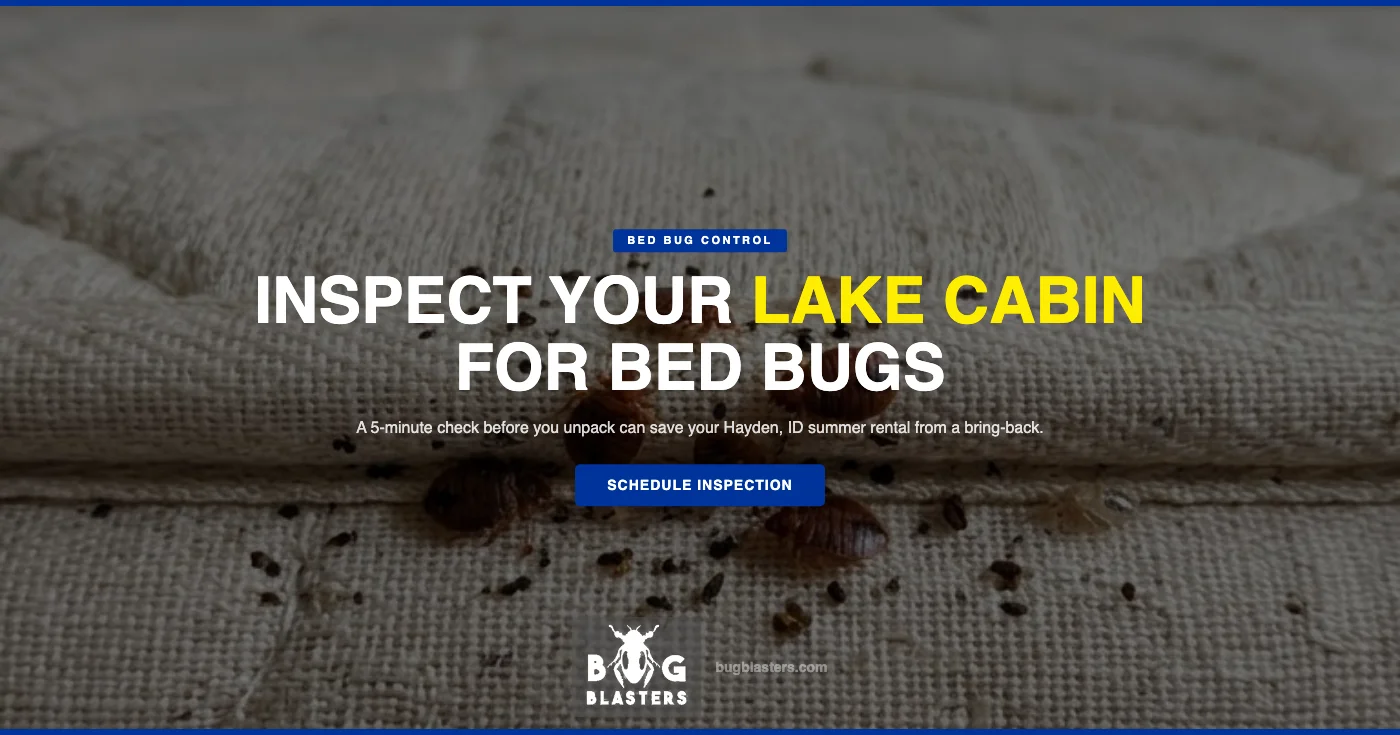
Summer at Hayden Lake means rented cabins, week-long family stays, and luggage that has been everywhere from a Phoenix airport to a Spokane motel in the last 72 hours. Our team gets a wave of bed bug calls every July and August from Hayden, ID homeowners who took a great vacation, came home, and a few weeks later started waking up with bites in a line down their arm. By then the colony is already established.
This guide walks Hayden vacationers through a proper bed bug inspection at a lake cabin before unpacking, the warning signs most people walk right past, and what to do if you find an active infestation mid-trip. If you have already brought something home, our bed bug exterminator team works across Hayden, Coeur d'Alene, Post Falls, and the rest of the Idaho Panhandle.
Why Hayden, ID Lake Rentals Are a Bed Bug Hotspot in Summer
Bed bugs do not come from dirt. They come from people, and Hayden Lake cabins see a remarkable amount of people from May through September. A typical four-bedroom rental on the east shore can host fifteen to twenty different guest groups in a single summer season, each arriving with suitcases that have spent a night or two in another lodging environment along the way. That turnover is exactly the environment Cimex lectularius exploits — fresh hosts, luggage staging on beds and floors, and cleanings focused on visible surfaces rather than mattress seams.
Construction style makes the problem worse. Older A-frames and lodge-style rentals around Hayden Lake, Coeur d'Alene Lake, and Lake Pend Oreille feature exposed wood beams, log walls, plank flooring, and wooden bed frames — all loaded with cracks and joinery seams that give the insects perfect daytime harborage within a few feet of the bed. Even newer Hayden rentals often include reclaimed wood headboards or rustic furniture that hides infestations better than a smooth metal frame.
According to the EPA's bed bug prevention guidance, hitchhiking on luggage is the single most common way these insects move between lodging properties. One guest can carry an unnoticed female into a Hayden cabin, that single bug can lay 200-plus eggs over six weeks, and the next several families through that rental inherit a multi-stage infestation nobody told them about.
How to Inspect a Cabin Bedroom Before You Unpack
The bed bug inspection our team teaches every traveling family takes about five minutes per Hayden, ID rental bedroom and dramatically lowers the odds of an unwanted souvenir. Do this before a single bag comes off the porch.
Start by leaving your luggage outside the cabin — on the porch, in the bed of your truck, or on a hard tile bathroom floor. Never on a bed, never on upholstered furniture, never on carpet. Bed bugs are night-active and slow, so a suitcase on tile for an hour while you inspect is essentially out of reach.
Walk to the first bedroom with a flashlight (your phone is fine). Pull the bedding back to expose the bare mattress. Bed bugs cluster where their food source rests, which means the mattress seam, the corners, and the box spring piping are inspection priority one. Run your light along every inch of the seam on the head end first, then both sides, paying special attention to where the mattress tag is sewn in.
Lift the mattress and check the box spring underneath. The thin gauze covering the bottom of most box springs tears easily and is a primary hiding spot. Then move to the headboard. Most Hayden cabin headboards are wood-mounted to the wall, with colonies hiding in screw holes, in the gap behind the headboard, and along the top edge where it meets the wall. Pull the bed four to six inches off the wall and shine your light into the gap.
Finish with the nightstand. Open every drawer, check inside corners, look behind it at the wall, and inspect any picture frame hanging within six feet of the bed.
Bed Bug Warning Signs Most Vacationers Miss
The insect itself is the rarest sign you will find on a five-minute inspection. Adults are about the size and color of an apple seed, nymphs are nearly translucent, and both spend daylight hours hidden in the smallest crevice they can find. What you are actually hunting for is the evidence the colony has left behind.
The most common tell is small rust-colored or dark brown spots on the mattress, box spring piping, or sheets. These are digested blood — fecal matter — and they smear if you wipe them with a damp tissue, which is the field test our team uses on real inspections. Clusters of these spots along a single seam are diagnostic of an active harborage within inches.
Look for cast skins. As nymphs grow through five molts, they shed an exoskeleton each time. The shed skins are translucent, amber-colored, and shaped exactly like the bug — finding them along a seam means a colony is reproducing actively, but most vacationers walk right past them assuming they are lint.
Watch for blood smears on sheets and pillowcases. When a guest rolls over and crushes a recently fed insect, the result is a small red-brown smear or comma-shape on the bedding. Pearl-white eggs about a millimeter long cemented into mattress seams or wood joinery are harder to spot but unmistakable up close.
Finally, in heavier infestations, there is a distinct musty, sweet smell — sometimes compared to over-ripe raspberries or wet coriander. If a Hayden cabin bedroom carries that smell, the infestation is not subtle and you should not be sleeping in that room.
What to Do If You Find Bed Bugs Mid-Vacation
Finding bed bugs in your Hayden lake rental on day one of vacation is awful, but the response is straightforward. Do not unpack. Keep every bag in the bathtub or on the bathroom tile — bed bugs cannot climb smooth porcelain easily and the tile gives you a clean staging area.
Contact the property manager or rental host immediately with photos of the evidence. Reputable Hayden vacation rental companies have backup units and will move you the same day; remediation becomes the host's responsibility before the next guest arrives. If you booked through Airbnb or VRBO, document the issue in the platform's messaging system, not just by text, so there is a written record for your refund or rebooking request.
If you already slept a night before discovering the bugs, bag every piece of clothing you wore or pulled out of your suitcase and treat it as contaminated until you can run it through a hot wash and high-heat dryer. The high-heat dryer cycle — 30 minutes minimum on the hottest setting — kills every life stage.
Protecting Your Hayden Home From a Cabin Bring-Back
The real risk in summer bed bug prevention for Hayden families is not what happens at the rental — it is what happens when you pull into your own driveway a week later. By the time bites show up in your master bedroom, the colony has already had three or four weeks of unobserved reproduction. Most of the calls our Hayden ID bed bug exterminator team takes in August and September trace back to a June or July trip.
According to the EPA's home protection guidance, the moment you arrive home is the highest-leverage opportunity to prevent an infestation. Our team gives every Hayden family this protocol:
- Do not bring luggage straight into the house. Unload everything in the garage, on the driveway, or onto a tarp on the patio.
- Open every suitcase outside and run all clothing — clean, dirty, worn, unworn — directly through a 30-minute high-heat dryer cycle. Heat kills the insects at every life stage.
- Vacuum the inside and outside of every suitcase, including seams and zipper pockets. Empty the canister or bag immediately into an outdoor trash receptacle.
- Store luggage in the garage, attic, or basement — never under a bed or in a bedroom closet.
- For two weeks after returning, check sheets and pillowcases for fecal spots and watch for unexplained bite lines, which often appear in groups of three along an exposed limb.
Most cabin bring-backs are caught at the dryer stage and never become an infestation. The Hayden homeowners we end up treating are almost always the ones who carried the suitcase straight into the master closet.
Why Bug Blasters Recommends Professional Treatment Over DIY
Bed bugs are one of the few pests where DIY treatment consistently makes the problem worse. Big-box store sprays kill the few insects you can already see and miss every life stage hiding in wall voids, outlet boxes, baseboard cracks, and the screw holes of the bed frame. Many household populations across the United States now show resistance to pyrethroid-based active ingredients, which are the foundation of nearly every over-the-counter spray and fogger.
Foggers are worse than ineffective — they scatter the colony. The bugs feel the propellant pressure, escape into adjacent rooms through outlets and baseboard gaps, and turn a one-bedroom problem into a whole-house problem. The National Pesticide Information Center documents this scatter effect and recommends against consumer foggers.
Effective treatment in a Hayden home requires equipment most homeowners do not own: high-temperature steam, encasements rated for full containment, and either a structured liquid-residual program or a whole-room heat treatment that holds the structure above 120 degrees for several hours. Every life stage — egg, nymph, adult — has to be addressed in the same cycle, or the survivors restart the colony within two weeks.
Local Bed Bug Help for Hayden, ID Homeowners
When our team responds to a call from a Hayden ID homeowner, we start with a full structural inspection — every bedroom, every adjoining wall, every piece of upholstered furniture within range of the master suite. We confirm activity, identify harborage points, and document the infestation footprint before we treat. North Idaho bed bug control work is binary: either you reach every life stage in the treatment cycle, or the colony rebuilds.
Treatment options depending on severity include targeted liquid residuals applied to harborage points and travel paths, steam treatment of mattresses and upholstered furniture, mattress and box spring encasement to lock survivors out of food, and full-room heat treatment for the most severe cases. Every plan we build for a Hayden home includes a follow-up inspection at the two- to three-week mark.
We work across the Idaho Panhandle — Hayden, Coeur d'Alene, Post Falls, Rathdrum, Dalton Gardens, Hayden Lake, and Sandpoint. Our general pest control service handles the seasonal pests that show up alongside summer bed bug calls.
Frequently Asked Questions About Bed Bug Inspections in Hayden, ID
How quickly do bed bugs reproduce after I bring them home from a Hayden cabin?
A single fertilized female lays one to five eggs per day, hatching in about a week. From one insect carried into a Hayden home, you can have a detectable infestation in four to six weeks and a heavy infestation by month three.
Can these insects survive a closed-up Hayden lake cabin through winter?
Yes. Bed bugs can survive months without feeding and tolerate temperatures down to the high 30s for extended periods. A cabin closed for the winter with an existing infestation will still have live bugs when the first guests arrive in May.
Are bed bug bites dangerous?
The bites are not known to transmit disease in North America, but they can cause significant skin reactions, allergic responses in sensitive people, and meaningful psychological stress. The structural and financial impact of an infestation is the bigger concern for most Hayden homeowners.
Will a hot Idaho summer kill these bugs on its own?
No. North Idaho summer temperatures inside a home rarely reach the 118-to-120-degree threshold required to kill the colony through heat alone, and any cooler harborage point — under a mattress, inside a wall void — gives them refuge.
How long does a professional treatment take?
A typical residential treatment runs two to four hours per visit, with a follow-up two to three weeks later. Heavier infestations or whole-home heat treatments can take a full day.