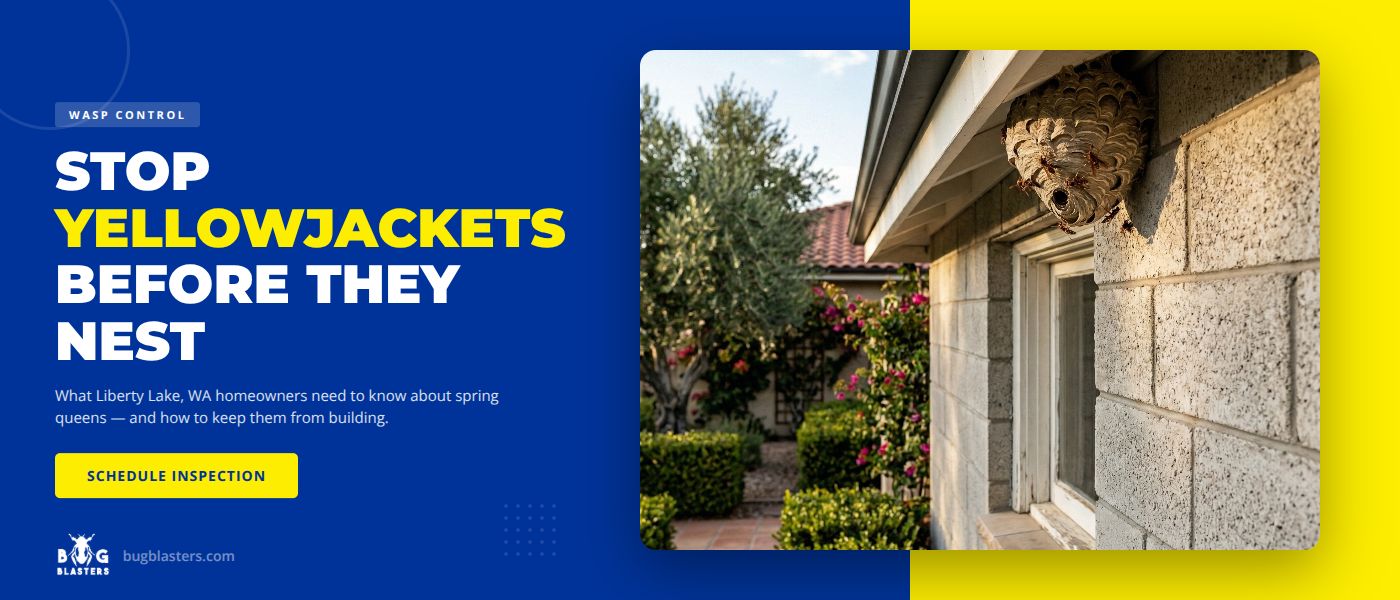
Spring in Liberty Lake, WA brings warmer afternoons, the first patio nights of the year — and a much smaller signal that often goes unnoticed: solitary yellowjacket queens emerging from winter shelters and looking for places to build new nests. By the time most homeowners notice wasp activity, those quiet spring scouting flights have already turned into colonies humming under deck boards or inside a wall void. Strategic wasp prevention in Liberty Lake, WA starts before peak summer, when interrupting a single queen can keep an entire colony from forming.
At Bug Blasters, we serve Liberty Lake along with the rest of the Spokane Valley and North Idaho, and spring is when our calls about hundred-strong colonies pick up. The good news: spring is also the easiest time of year to get ahead of the problem. In this guide we cover why spring drives wasp activity here, how to spot early queen behavior, where wasps nest on local properties, what homeowners can do now, and when to bring in our team for professional yellowjacket control in Liberty Lake.
Why Spring Is Prime Wasp Season in Liberty Lake, WA
Eastern Washington's seasonal swing is dramatic. After months of freezing temperatures and snow cover across the Spokane Valley, daytime highs in April and May climb into the 50s and 60s. That warming pattern triggers the entire wasp season. Mated yellowjacket queens spend the winter tucked into protected spots — beneath loose bark, inside wood piles, under siding gaps, in sheds and detached garages — and emerge as soon as temperatures stay consistently mild.
According to the Pacific Northwest Pest Management Handbook, only the queen survives winter for most local yellowjacket and paper wasp species. Once she emerges, she has a narrow window to find a nesting cavity, build a starter comb, lay her first eggs, and feed those larvae herself until the first workers take over. That phase typically runs from mid-April through late May here.
The species we see most often around Liberty Lake homes are the western yellowjacket (Vespula pensylvanica), the German yellowjacket (Vespula germanica), bald-faced hornets, and several paper wasp species. They share the same spring rhythm: a single queen scouts and starts the nest, the colony grows from one wasp to dozens within six to eight weeks, and by midsummer it can hold several hundred. Catching that progression at week one is the goal of spring wasp control in Washington.
Spotting Yellowjacket Queens Before They Build a Nest
Spring queens look different from the workers we see in August. They are noticeably larger — often three-quarters of an inch or more — and they fly slowly, methodically, and alone. If you notice a single large yellow-and-black wasp inspecting your eaves, deck rim, attic vents, or the edges of your shed in April or May, you are very likely watching a queen searching for a nest site.
Queens prefer cavities that are dry, sheltered, and undisturbed. They will hover at potential entry points, land briefly, walk inside, and leave again — a kind of real-estate tour that can last several days before she commits. Once she settles, the first sign of activity for most homeowners is a small papery comb the size of a quarter, followed by a golf-ball-sized starter nest with the queen tending it alone.
This is the most productive moment in the entire season for prevention. A single queen interrupted in April will not produce the workers, the larger summer nest, or the late-summer foragers that dominate Liberty Lake patios in August. The catch: spring queens look unthreatening, and homeowners often dismiss the slow, solo flights as harmless. They are not — they are the foundation of every late-summer problem.
Common Wasp Nesting Spots Around Liberty Lake Homes
Liberty Lake properties offer wasps a long menu of attractive nesting sites. Mature yards back up to wooded areas and shoreline; older homes have settled siding, hidden soffits, and crawl-space access points; newer subdivisions add deck framing, playsets, and storage sheds that wasps treat as ideal cavities.
The most common nesting locations we encounter on Liberty Lake homes include:
- Eaves, soffits, and gable vents — sheltered overhead spaces are the top choice for paper wasps and aerial yellowjackets
- Attic and wall voids — German yellowjackets exploit small gaps where siding meets trim, then build large concealed nests inside
- Ground burrows and rockeries — western yellowjackets often take over abandoned rodent burrows or build under landscaping rock
- Deck framing and underside of stairs — undisturbed cavities under decks attract every species we see locally
- Sheds, detached garages, and outbuildings — these structures provide overwinter shelter for queens and prime nesting space in spring
- Playsets, BBQ grills, and outdoor storage bins — anything left undisturbed for several weeks can host a starter nest
- Hollow trees and landscape stumps — common around the Spokane Valley's older mature lots
Wasps also need water and food nearby. Liberty Lake's blend of irrigation, ornamental plantings, and proximity to the lake supplies both — which is why a property can be largely wasp-free one year and overrun the next.
Spring Prevention Steps Every Homeowner Can Take
Homeowners can do real, meaningful work this time of year to lower wasp pressure for the entire summer. The single biggest principle: deny queens the cavities they want before they commit to a nest. These steps are most effective from late March through the end of May in the Liberty Lake area.
Inspect and Seal Entry Points Now
Walk the exterior of your home and find gaps where siding meets trim, where soffit panels have separated, and where utility lines enter the wall. Caulk or screen any opening larger than a quarter-inch. Pay special attention to attic, gable, and dryer vents — favorite German yellowjacket entry points. Sealing now is far easier than dealing with an established colony later.
Take Down Old Nests From Last Year
Old nests are not reused, but their presence tells passing queens the location is viable. Knock down any visible old nests in eaves, sheds, and attics during cool morning hours and dispose of them in a sealed bag.
Reduce Spring Food and Water Sources
Spring queens hunt for protein and sugars. Keep trash bin lids tight, rinse recyclable cans, cover compost piles, and repair dripping faucets or irrigation leaks. Hang hummingbird feeders well away from seating areas and clean them weekly.
Watch the Eaves and Sheds Weekly
Make a quick walk-around part of your spring routine. Look under eaves, into garage rafters, inside the BBQ cover, and along deck framing. Catching a quarter-sized starter nest in May is a five-minute fix; the same nest in August is a several-hundred-wasp emergency.
Consider a Preventive Perimeter Treatment
For homes that have dealt with multiple wasp seasons in a row, or properties bordering wooded or undeveloped land, a preventive spring perimeter treatment makes the structure itself less attractive to scouting queens. This pairs well with our recurring general pest control service and dramatically reduces the chance of a nest establishing in concealed areas.
Why DIY Wasp Removal Often Backfires
We understand the impulse to grab an aerosol can off the shelf and handle a nest yourself. For a small, exposed paper-wasp comb caught early in spring, a careful homeowner can sometimes manage it. For anything more — and especially for yellowjacket nests in wall voids, ground cavities, or attic spaces — DIY removal carries serious risks.
Yellowjackets defend their nest aggressively, and a single colony can deliver dozens of stings within seconds when disturbed. As Cleveland Clinic notes about wasp stings, multiple stings can trigger severe reactions even in people with no prior allergy history, and anaphylaxis is a real risk. Spraying a nest from the ground or off a ladder rarely reaches the queen, often leaves the colony intact to rebuild, and exposes the homeowner to swarming attacks. Concealed nests are even riskier — spraying into a wall opening frequently drives the colony into the living space, turning an exterior problem into an interior emergency.
Partial DIY removal almost always means we get called out anyway, with a more agitated colony than we would have faced on the first visit. Spring queen interruption avoids that scenario entirely. Hornet and yellowjacket control done right targets the queen and the developing colony with the equipment and protective gear made for the job.
When to Call Bug Blasters for Professional Wasp Control
Some situations are better handled by our team from the first sign of activity. Call Bug Blasters when you notice any of the following on your Liberty Lake property:
- A nest larger than a tennis ball, or any nest with visible activity — colonies past the starter stage are unpredictable and high-risk to disturb
- Nests inside walls, soffits, attics, or any enclosed space — concealed nests require equipment and access strategies homeowners do not have
- Ground nests in lawn, rockery, or near walkways — western yellowjacket ground colonies are dangerous to mow over or step near
- Repeat nesting in the same area year after year — properties that attract wasps annually need preventive treatment, not seasonal reaction
- Anyone in the household with a sting allergy — never take that risk on a DIY removal
Our wasp prevention program for Liberty Lake homeowners starts with a property inspection, identifies active and potential nesting sites, and applies targeted treatment to the queen, the colony, and the entry points. We follow up to confirm the colony is gone and adjust the perimeter program to keep the property unattractive to future scouting queens. Spring is the most effective window — colonies are smaller, less defended, and easier to permanently remove.
We serve Liberty Lake along with Post Falls, Coeur d'Alene, Spokane Valley, Hayden, and Rathdrum. To schedule a spring property inspection or get on a recurring program before peak season, reach our team through our contact page. Catching queens in April and May is the difference between a quiet summer and a backyard you cannot use in August.
Frequently Asked Questions About Wasp Prevention in Liberty Lake
When does wasp season start in Liberty Lake, WA?
Yellowjacket and paper wasp queens in Liberty Lake typically emerge in mid-April once daytime temperatures stay in the 50s and 60s. Queen scouting and starter-nest construction runs through May. By June the first generation of workers has taken over food gathering, and populations climb steadily through August and into September.
How can I tell if a wasp is a queen?
Spring queens are larger than summer workers — often three-quarters of an inch or more — and fly alone, slowly, and methodically. A single large yellow-and-black wasp inspecting eaves, vents, or shed corners in April or May is almost certainly a queen evaluating nesting sites.
Will old wasp nests on my house attract new wasps?
Wasps do not reuse old nests, but their presence signals to passing queens that the location is viable. Removing old nests during cool spring mornings is one of the most effective free prevention steps Liberty Lake homeowners can take.
Is DIY wasp spray enough for a small spring nest?
For a clearly visible paper-wasp comb the size of a quarter or smaller, a careful homeowner with proper protective clothing can sometimes manage it. For yellowjacket nests, ground nests, concealed nests in walls or eaves, or anything with active workers, professional treatment is the right call.
Does Bug Blasters serve Liberty Lake, WA for wasp control?
Yes. Bug Blasters provides wasp pest control in Liberty Lake, WA along with yellowjacket and hornet services across eastern Washington and North Idaho. Reach our team through our contact page to schedule a spring property inspection before peak season arrives.
Are your wasp treatments designed with families in mind?
Yes. Our technicians follow all label instructions and application guidelines, and we walk through the specific products and methods used at the time of service. We will also explain any short-term steps to take around treated areas so your family and pets stay comfortable.