
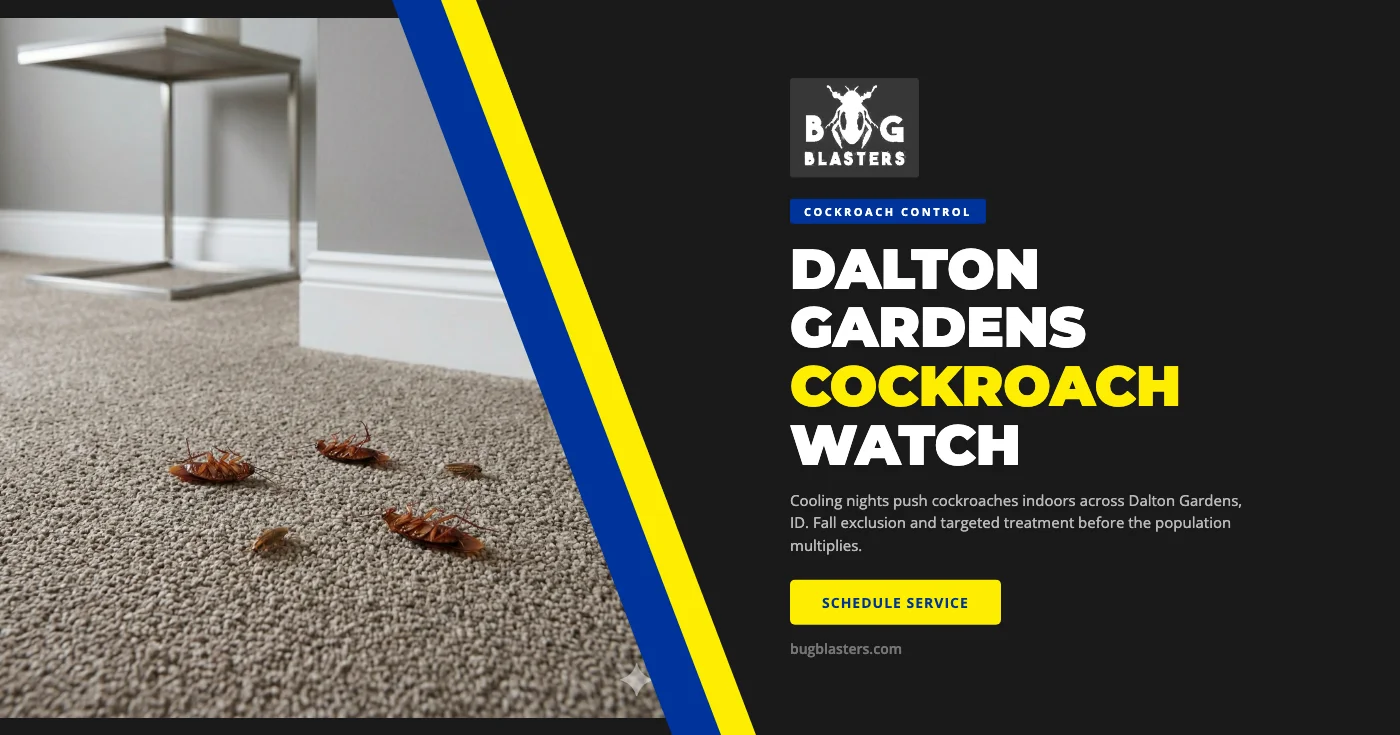
If cooler mornings have you noticing more insect activity around baseboards or cabinet corners in your Dalton Gardens, ID home, you are seeing exactly what our team sees every fall. Cockroach populations across North Idaho spend late summer building up in outdoor harborage, and once night temperatures drop into the 40s across Kootenai County, they push toward whatever warm structure will take them. September and October are our two busiest months for cockroach calls — and the homes that catch the problem early save weeks of frustration compared with the ones that wait until the population is entrenched.
Why Cockroach Activity Continues After Summer in Dalton Gardens, ID
Homeowners here often assume that as the growing season winds down and the first frosts settle in, indoor pests should be winding down too. Cockroaches do not follow that pattern. Every species that shows up in a Dalton Gardens, ID kitchen originally evolved in a much warmer climate, and every one of them is looking for a warm, humid microclimate to ride out the North Idaho winter. Once outdoor temperatures consistently drop below the mid-50s, cockroach activity outside slows dramatically, and the population that had been living in mulch, woodpiles, and crawl spaces starts pressing hard against the building envelope.
What that means for a Dalton Gardens, ID homeowner is that the roach you saw once in July on the back patio is now the roach potentially breeding behind your baseboard in October. Fall is when outdoor populations become indoor infestations, and the reason so many local families first notice a problem when kitchen lights flick on late at night.
The Most Common Cockroach Species Found in North Idaho Homes
The four cockroach species we identify most often in Dalton Gardens, ID homes and across the wider Kootenai County service area each behave a little differently, and correct identification is the first step in a treatment that actually works. The University of Idaho Extension and Pacific Northwest pest management guidance both confirm these are the species Dalton Gardens, ID homeowners should know.
German cockroach (Blattella germanica). By far the most common indoor cockroach in Dalton Gardens, ID and across North Idaho. Adults are about 5/8 inch long, light brown to tan, with two dark parallel stripes running lengthwise behind the head. German cockroaches are strictly indoor pests once established — they cannot survive North Idaho winters outside and depend entirely on heated buildings. A single fertilized female can produce up to 400 offspring in a year, which is why an unnoticed introduction in September can be a full-blown kitchen infestation by Christmas in a Dalton Gardens, ID home.
American cockroach (Periplaneta americana). Much larger, at 1 to 1.5 inches, and reddish-brown with a pale figure-eight pattern behind the head. American cockroaches prefer high-moisture environments in Dalton Gardens, ID basements and utility rooms, and often move indoors via floor drains, sump pits, and pipe penetrations as the ground cools. They fly short distances at warm temperatures, which is why some homeowners see the occasional large roach on a warm September evening.
Oriental cockroach (Blatta orientalis). Also called the "water bug," about an inch long, and very dark brown to nearly black. Oriental cockroaches love damp, cool locations — the exact conditions found under a Dalton Gardens, ID deck, in a crawl space that has taken on snowmelt moisture, or in a garage floor drain. Fall is the season we most often trace an Oriental infestation back inside, because the population that summered outside moves through gaps around utility lines when the ground starts to chill.
Brown-banded cockroach (Supella longipalpa). Smaller and lighter than the German, with two pale bands across the wings. Brown-banded cockroaches prefer drier, warmer spots higher in the home — cabinet uppers, electronics, closets, and behind picture frames — which makes them harder to find and easier to spread to other rooms unnoticed.
Signs You Have a Cockroach Infestation Before It Spreads
Catching cockroaches early in a Dalton Gardens, ID home is the difference between a targeted, contained treatment and a whole-house recovery job. The population grows exponentially, so the same one-week-old evidence a homeowner might dismiss in September becomes a serious infestation by Halloween. Here is what our team teaches Dalton Gardens, ID families to look for:
Droppings. German cockroach droppings look like small black or dark-brown specks — often mistaken for pepper or coffee grounds — clustered in cabinet corners, along the edges of countertops, and under kitchen appliances. American and Oriental droppings are larger, cylindrical, and blunt on the ends. Any consistent pattern of dark specks in a Dalton Gardens, ID pantry or under-sink cabinet is worth a professional inspection.
Egg cases (oothecae). Cockroach females carry or glue distinctive purse-shaped egg cases into hidden seams. German cockroach oothecae are light brown and about the size of a grain of rice, often attached to the underside of a shelf. Finding even a single spent case is confirmation of an active breeding population — not an isolated straggler.
A musty, oily odor. Larger cockroach populations produce a distinctive musty smell from aggregation pheromones. Most homeowners never notice this — treatment usually happens well before the population is that dense — but if a cabinet or a laundry room smells persistently off, that odor is a signal.
Live sightings after dark. Cockroaches are nocturnal. Flipping on a kitchen or bathroom light at 1 a.m. and seeing a fast-moving insect skitter behind an appliance is the classic first sighting. If you see one during daylight hours, the population is already large enough that the daytime hiding spots are full.
Shed skins. Cockroaches molt several times as they mature, and each translucent cast skin left behind in a cabinet corner or along a baseboard is evidence of an established, breeding population — not a one-off visitor.
Why Cockroaches Are Harder to Eliminate Without Professional Help
Once cockroaches are confirmed in a Dalton Gardens, ID home, the question every homeowner faces is whether to try over-the-counter products first or call a professional. The honest answer, learned by every family that has tried the retail route, is that cockroaches are one of the pests where the do-it-yourself approach almost always disappoints and often makes the problem harder to resolve.
Store-bought sprays and foggers rarely reach the harborage zones where cockroaches actually live — inside wall voids, behind refrigerator motors, under dishwashers, and around plumbing penetrations. Foggers, in particular, push cockroaches deeper into wall cavities and untouched rooms. What began in one kitchen can become a whole-first-floor issue by month two.
Cockroach egg cases are the second challenge. Oothecae are chemically resistant, and the nymphs inside are protected from most contact insecticides until they hatch. Effective cockroach control Dalton Gardens ID homeowners can rely on requires a treatment sequence that intercepts the population as those eggs hatch and before the nymphs mature into breeding adults — a rhythm that depends on knowing the species, the reproductive cycle, and the harborage layout in a specific home.
Finally, the health stakes matter. Cockroach droppings, saliva, shed skins, and body fragments are a documented allergen source. The Centers for Disease Control and Prevention lists cockroach allergen as a leading indoor trigger for pediatric asthma, and studies of German cockroach allergen have shown a direct link with asthma symptom severity in children. Getting the population out is not just a comfort question — it is a health question, especially for households with kids, elderly residents, or anyone with respiratory conditions.
How Bug Blasters Treats Cockroach Infestations in Dalton Gardens
Every Dalton Gardens, ID cockroach job we run starts with a thorough inspection. Our technician walks the home top to bottom, but especially through the kitchen, laundry, bathrooms, utility spaces, and any garage or crawl space attached to the living envelope. We identify the species, map the harborage zones, and look for the entry vectors that let the population in — floor drains, pipe cuffs, dryer vents, and gaps under exterior doors are common findings on our inspections.
From there, our Cockroach Pest Control program uses a combination of targeted gel baits, insect growth regulators, dust in appropriate wall-void locations, and residual applications in cracks and crevices. The specific combination depends on the species and the size of the population. We do not fog. We do not blanket-spray. We place products where cockroaches actually go, so the population carries the active ingredient into the harborage on their own.
The final piece is follow-up. Cockroach egg cases need to hatch before their contents can be intercepted, so we schedule the next visit around the reproductive cycle — usually two to three weeks after the initial treatment for a German cockroach job — and re-inspect the harborage zones to confirm the population is collapsing. Persistent monitoring is what turns a promising first knockdown into a durable result in a Dalton Gardens, ID home.
Preventing Cockroaches From Returning to Your Home This Fall
Treatment gets the current cockroach population out of a Dalton Gardens, ID home. Prevention keeps the next one from getting a foothold. These are the fall habits and small home-improvement projects that make the biggest difference across our Dalton Gardens, ID service area:
Seal entry points. Cockroaches enter through gaps a quarter-inch wide or larger. Walk the exterior of the house on a cool October afternoon and note every gap around utility lines, dryer vents, hose bibs, and the sill plate at the foundation. Silicone caulk, expanding foam, and weatherstripping at exterior doors solve most of what you will find. Pay particular attention to garage-to-house entries — attached garages are one of the most common entry paths on the Dalton Gardens, ID homes we service.
Manage moisture. Cockroaches cannot survive long without water. Repair leaky faucets, replace worn plumbing gaskets under kitchen and bathroom sinks, and make sure the dishwasher drain line and refrigerator icemaker line are dry and clean. A dehumidifier in a Dalton Gardens, ID crawl space or basement carrying more than 55% relative humidity pays for itself.
Deny food. Store cereal, flour, sugar, pet food, and pantry staples in sealed containers. Wipe down kitchen counters nightly, empty small trash cans daily, and never leave dishes overnight in the sink. Pet food dishes should be picked up between meals — kibble left on a laundry-room floor is one of the reliable food sources in every home we inspect.
Declutter harborage. Cardboard boxes, stacked paper, and rarely-moved appliances are prime cockroach hiding spots. A fall clean-out of the pantry and garage removes dozens of potential harborage sites and makes future inspections faster.
Why Dalton Gardens Homeowners Trust Bug Blasters for Year-Round Protection
Our team lives and works across North Idaho, and the mix of older ranch homes, newer builds along Government Way, and rural properties north of the interstate gives our Dalton Gardens, ID clients a technician who already knows the local building patterns, the seasonal pest pressure, and how the microclimate around a Kootenai County home shifts from spring through the first hard freeze. That local familiarity is what makes the difference between a generic cockroach spray and a treatment plan calibrated to your home.
Many of the families we serve start with a cockroach call in the fall and then move into our General Pest Control program to keep spiders, rodents, ants, and other seasonal pests from following the same paths inside over the winter and spring. The two programs work together — the same exterior sealing, moisture control, and inspection cadence that stops cockroaches also blocks the pests that would otherwise take their place.
If you have seen even one cockroach in your Dalton Gardens, ID home, or noticed dark specks or an unexplained odor in a cabinet, that is the right moment to reach out. Cockroach populations do not shrink on their own. Call Bug Blasters today and let our team give you the inspection, the plan, and the peace of mind that comes with knowing your home is protected before winter settles in over North Idaho.