
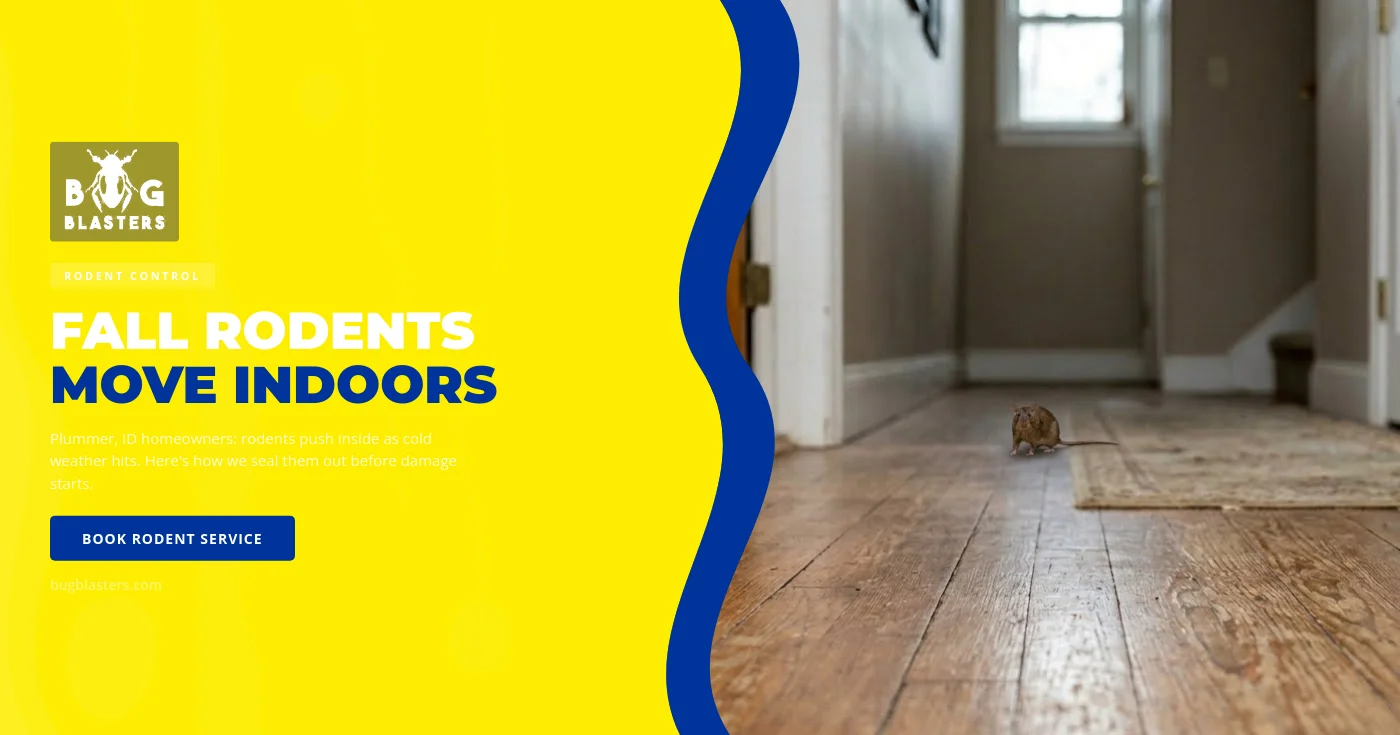
If the first frosty mornings have you hearing scratches in the ceiling or finding chewed packaging in the pantry of your Plummer, ID home, you are seeing exactly what our team sees every October. Mice and rats across North Idaho spend late summer and early fall building up in woodpiles, outbuildings, and the fringe of forested lots, and once overnight temperatures drop into the 30s, they push toward whatever warm structure will take them. October is the single busiest month on our rodent calendar — and the Plummer, ID homes that catch the problem in the first week save weeks of effort compared with the ones that wait until the population is nesting in the walls.
Why Plummer, ID Homes Attract Mice and Rats as October Temperatures Drop
Plummer sits on the Palouse-meets-panhandle plateau at about 2,600 feet, and the shoulder season here is short. One week overnight lows are in the mid-40s, and the next week they are flirting with freezing. That compressed transition is exactly why rodent control Plummer ID homeowners book in October is so much more urgent than the same conversation would be in a milder climate. As temperatures drop, deer mice, house mice, Norway rats, and pack rats look for warmer, food-rich shelter, and many of the rodents that were living in a hay barn, under a deck, or in the mulch along the foundation start looking for a warmer address — your home is an easy target.
What our team sees across the Plummer, ID service area is a consistent fall pattern. The first push happens the week overnight lows drop below 40. The second, larger push follows the first hard freeze — usually mid-October through early November. By the time the ground is frozen, rodents that found a way in are nesting, breeding, and chewing, and the window for a quick, targeted treatment has already narrowed. Fall is when outdoor populations become indoor infestations in a Plummer, ID home, and the reason so many families here first notice droppings or hear scurrying overhead right around the time the pumpkins come out.
How Mice and Rats Enter Idaho Homes Through Surprisingly Small Gaps
Homeowners are always surprised when our technician points at a dime-sized gap along a sill plate and tells them that is a rodent highway. The University of Idaho Extension and Pacific Northwest pest management guidance both confirm what we measure on every inspection: a house mouse can squeeze through an opening about a quarter-inch wide, roughly the size of a #2 pencil, and a juvenile mouse needs even less. A Norway rat only needs a half-inch gap. If a pencil fits through the opening, a mouse fits through the opening — and once one is in, scent trails bring the rest of the population after it.
The entry points we flag most often on Plummer, ID homes are predictable once you know where to look. Dryer vents that are missing their louvered covers or whose covers are cracked are the most common finding. Pipe penetrations where plumbing or utility lines enter the foundation almost always have gaps around them — the drilled hole is wider than the pipe, and the gap sits open for years. Rim-joist and sill-plate junctions on older ranch-style and manufactured homes along the Highway 95 corridor settle over time and open small horizontal gaps that run the length of a wall. Garage-to-house entries are another reliable path — attached garages are not usually weatherstripped the way exterior doors are, and the quarter-inch strip under a garage service door is exactly the mouse highway it sounds like.
Chimneys without proper caps, gable vents without hardware cloth, and crawl space access doors that no longer seat flush round out the top of our Plummer, ID entry-point list. On a cold October afternoon, half an hour with a flashlight and a notepad will reveal most of what a mouse or rat already knows about your home.
Signs of a Rodent Infestation in Your Plummer Home Before It Gets Worse
Catching rodents early in a Plummer, ID home is the difference between a short, contained treatment and a multi-visit recovery job. A single pair of house mice can produce five to ten litters a year, so the one-week-old evidence a homeowner might dismiss in October becomes a serious infestation by Thanksgiving. Here is what our team teaches Plummer, ID families to watch for in the first weeks of fall:
Droppings. House mouse droppings are the size of a grain of rice, dark, and pointed on the ends. Rat droppings are two to three times larger. The highest-value place to look is under the kitchen sink, along the back of pantry shelves, in the top corners of garage shelves, and in a utility room where the furnace or water heater lives. Any consistent pattern of pellet-shaped droppings in a Plummer, ID kitchen or utility space is worth a professional inspection.
Chewed packaging and gnaw marks. Rodents chew through cardboard, thin plastic, and paperboard overnight. The classic finding is a corner of a cereal box with a semicircular bite out of it, or a bag of pet kibble with a dime-sized hole chewed through near the bottom seam. Gnaw marks on wooden trim, baseboards, or the lower edge of cabinet doors are another signal, especially when the marks look fresh and pale against weathered wood.
Scurrying and scratching noises. The classic Plummer, ID fall call starts with a homeowner hearing something in the ceiling or in an interior wall at night. Mice are nocturnal, and the sounds — a soft scratching, a quick scurrying patter, occasionally a thump — travel along wall cavities and ceiling joists. If the noise is only above one room, that is usually where the entry point is.
Grease marks and rub trails. Rats and larger mice travel the same paths repeatedly, and their oily fur leaves a dark smudge along baseboards, foundation edges, and the undersides of garage shelves. Those rub marks are a map of the rodent highway, and they usually point straight at the entry point.
Nests. Shredded insulation, chewed cardboard, upholstery fluff, and bits of newspaper piled in a hidden corner of a garage, attic, or crawl space is a nest. Finding one is confirmation of an established, breeding population — not a single straggler who wandered in.
Health Risks That Come With a Rodent Problem in Your Home
Treating a rodent infestation in a Plummer, ID home is a comfort question, but it is also a health question, and that is why our team recommends professional handling rather than a hardware-store trap-and-wait approach. Rodents are reservoirs for several diseases documented in rural North Idaho, and their droppings, urine, and nesting material can trigger allergic reactions and asthma symptoms in sensitive family members.
Deer mice, which are common across the forested parts of our Plummer, ID service area, are the primary carriers of hantavirus pulmonary syndrome in the western United States. The Centers for Disease Control and Prevention warns that hantavirus can be transmitted by inhaling aerosolized particles from dried rodent droppings and urine — which is exactly what happens when a homeowner sweeps or vacuums a mouse-contaminated attic, crawl space, or garage without the right protective procedures. Rodents are also linked to leptospirosis, salmonellosis, rat-bite fever, and lymphocytic choriomeningitis, and their nests and droppings aggravate indoor allergen loads for anyone with respiratory sensitivity.
Beyond the pathogens, rodents cause real structural damage. Mice and rats chew wiring, which is one of the most common hidden fire-ignition sources in older rural homes, and they tunnel through blown-in insulation in attics, reducing R-value and increasing winter heating bills. The quiet damage adds up long before most homeowners realize how large the population behind the walls has grown.
How Bug Blasters Inspects and Treats Rodent Infestations in Plummer, ID
Every Plummer, ID rodent job we run starts with a thorough inspection. Our technician walks the entire exterior of the home — foundation, siding, utility penetrations, roofline, chimney, gable vents, crawl space access, and the garage envelope — and then works through the interior from the lowest level up. The goal of that first visit is to map three things: the species we are dealing with, the entry points letting them in, and the harborage zones where they are nesting and breeding.
From there, our Rodent Control program uses a combination of tamper-resistant exterior bait stations, targeted interior snap-trap placement in harborage zones, and species-specific trapping protocols. For deer mice in rural Plummer, ID settings, we lean on interior trapping and exclusion rather than rodenticide, because of the hantavirus concern and because deer mouse populations are often reinforced from the surrounding forest. For house mice and Norway rats on more suburban Plummer, ID properties, we build a perimeter protection ring with exterior stations and treat the interior with trapping until catch rates drop to zero.
The piece most homeowners do not realize matters most is exclusion — the sealing work that keeps the next rodent from getting in. Trapping without exclusion is a treadmill. Our team uses copper mesh, hardware cloth, sheet metal, concrete patching, foam-and-mesh sandwiches, and door-sweep upgrades to close every entry we flagged on the inspection. The combination of trapping and exclusion is what turns a successful first-month knockdown into a durable rodent-free result in a Plummer, ID home.
Follow-up visits confirm the population is gone, re-inspect the harborage zones, and re-check the exterior as temperatures drop further. Rodent pressure in Plummer, ID peaks between the first hard freeze and the Christmas week cold snap, so the inspection cadence through November and December is the window where persistent monitoring pays off.
Sealing Your Plummer, ID Home to Prevent Future Rodent Entry
Treatment gets the current rodent population out of a Plummer, ID home. Prevention keeps the next generation from getting a foothold. These are the fall habits and small home-improvement projects that make the biggest difference across the Plummer, ID homes we service:
Walk the perimeter. On a cool October afternoon, walk the entire exterior of the house with a flashlight and a notepad. Mark every gap larger than a quarter-inch — around utility lines, dryer vents, hose bibs, chimney flashing, and the sill plate at the foundation. A patient hour here saves weeks of trapping later.
Seal the gaps. Copper mesh or stainless steel wool packed into a gap and then sealed over with silicone caulk or foam is the industry-standard rodent-proof patch. Expanding foam alone is not enough — mice chew through it. For door sweeps and garage door bottom seals, replace anything that no longer seats flush. On older Plummer, ID homes along Highway 95 and the rural lots south toward Hangman Creek, pay particular attention to the crawl space access door and the sill-plate junction.
Manage the yard. Woodpiles against the house, piled brush, and tall grass along the foundation give rodents cover right next to their entry point. Move woodpiles at least 20 feet from the house, trim grass tight along the foundation, and clear brush off the first six feet of perimeter.
Deny food. Store pantry staples — cereal, flour, pet food, birdseed — in sealed hard-sided containers. Never leave pet food out overnight. Clean the kitchen counters and vacuum crumbs nightly through the cold months. A single tablespoon of kibble spilled behind the dog bowl is a nightly meal for a mouse.
Reduce indoor harborage. Cardboard boxes stacked in a Plummer, ID garage or utility room are prime rodent nesting material. A fall clean-out and a switch to lidded plastic bins removes the softest, most attractive harborage sites in a typical home.
Why North Idaho Homeowners Trust Bug Blasters for Fall Pest Control
Our team lives and works across the North Idaho panhandle, and the mix of rural lots along the reservation, lakefront homes down toward Heyburn State Park, and newer builds along Highway 95 gives our Plummer, ID clients a technician who already knows the local building patterns, the seasonal pest pressure, and how the microclimate around a Benewah County home shifts from the first fall frost through the January cold snap. That local familiarity is what makes the difference between a generic trap-and-check approach and a rodent plan calibrated to how heat, moisture, and wildlife actually move around your property.
Many of the families we serve start with a rodent call in October and then move into our General Pest Control program to keep spiders, ants, cockroaches, and other seasonal pests from following the same paths inside through winter and spring. The two programs work together — the same exterior sealing, moisture control, and inspection cadence that stops rodents also blocks the pests that would otherwise take their place.
If you have seen even one mouse in your Plummer, ID home, found droppings in the pantry, or heard scurrying overhead at night, that is the right moment to reach out. Rodent populations do not shrink on their own, and every week of delay in October costs weeks of effort by December. Contact Bug Blasters today and let our team give you the inspection, the plan, and the peace of mind that comes with knowing your home is protected before winter settles in across the panhandle.