
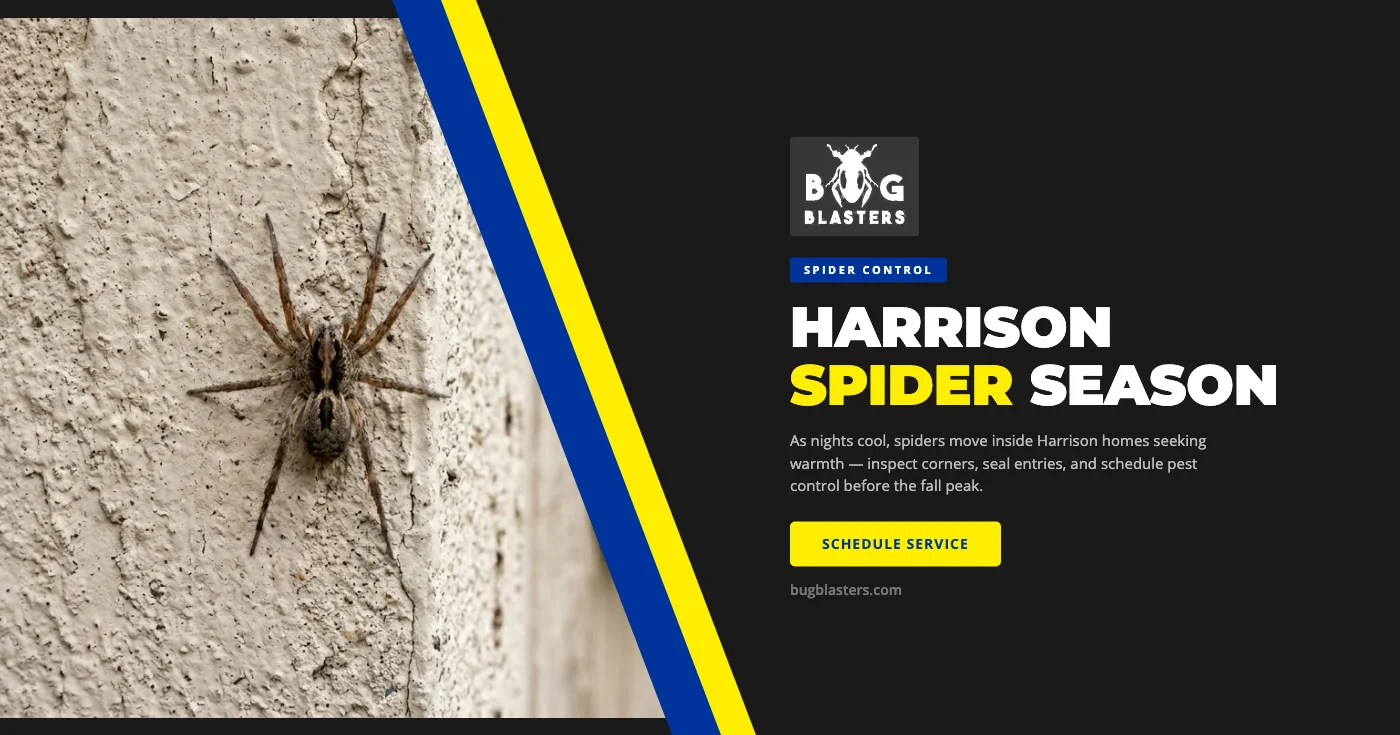
If you've started noticing more spiders inside your Harrison, ID home this September, you're seeing a pattern we watch play out along the eastern shore of Lake Coeur d'Alene every fall. At Bug Blasters, spider control Harrison ID calls climb in a predictable wave as Labor Day passes and the first cool nights settle in over Kootenai County. Biology, elevation, and lakefront geography all point the same direction — indoors — and understanding what's driving it helps you get ahead of the season before webs multiply and males start wandering across the living-room floor at dusk.
Why Spiders Move Indoors Every Fall in North Idaho
Two forces overlap in September to push spider activity into Harrison, ID homes. The first is reproductive: hobo spiders, giant house spiders, and most of the other web-builders across our region reach mating maturity in late summer. Males stop maintaining a fixed web and begin wandering in search of females — which is why they suddenly turn up in bathtubs, at the base of a wall, or scurrying across a hallway after dark. The females stay put; the males' new mobility is what makes the population feel much larger overnight.
The second force is temperature. Harrison, ID sits at about 2,274 feet on the eastern edge of Lake Coeur d'Alene, and the September temperature swing can be dramatic. A 78-degree afternoon along the lakefront can tip into the mid-40s by dawn. Spiders are ectothermic — their body temperature tracks the air around them — so as evenings cool, their metabolism slows and their outdoor hunting efficiency drops. They begin following warmth gradients: the heat radiating off a foundation, the gap under a garage door, the leak of warm air from a poorly sealed rim joist. Every one of those cues leads back to your home.
The University of Idaho Extension notes that spider activity across northern Idaho peaks in late summer and early fall, coinciding with mating season and the first cool nights. That is not a Harrison, ID anomaly — it is the annual rhythm, and it is why September and early October are consistently our busiest weeks for spider control Harrison ID work.
Common Spider Species Found in Harrison, ID Homes
Not every spider you find in a Harrison, ID home carries the same weight. Here are the species we identify most often inside houses along the lakeshore and up into the surrounding hills:
Hobo Spider (Eratigena agrestis). The hobo spider is one of the most familiar residential spiders across Kootenai County, including Harrison, ID. Medium-sized, brown, and unmarked on the legs, hobos build funnel-shaped webs low to the ground — inside garages, along baseboards, in the corners of unfinished basements, and in stacked boxes. They are poor climbers, so most sightings happen at floor level. Because males wander during September to breed, this is when Harrison, ID homeowners typically first notice them.
Giant House Spider (Eratigena atrica). Frequently mistaken for the hobo, the giant house spider is now the most common large indoor spider across the Pacific Northwest, and we see plenty of them in Harrison, ID homes each fall. Their legs show noticeable banding — a quick way to tell them apart from a hobo — and they are among the fastest spiders in North America. They are harmless, but their sheer size unsettles most homeowners the first time one appears on a bathroom floor.
Cellar Spider (Pholcus phalangioides). Long-legged, delicate, and often called daddy longlegs, cellar spiders build loose, tangled webs in cool, dark, slightly damp spaces. In Harrison, ID homes near the lake, they concentrate in basements, crawl spaces, and behind stored items in the garage. Harmless to people, they can build up quickly in numbers when they go undisturbed.
Orb Weavers. Cross orb weavers and related species are the classic outdoor spiders you see stringing large circular webs around porch lights, eaves, and lakeside decks across Harrison, ID in September. They mostly stay outside chasing the insects drawn to your exterior lighting, but their webs across a doorway or a screen porch make them the most visible spider of the season.
Black Widow (Latrodectus hesperus). Less common than hobos and giant house spiders in Harrison, ID but present — especially in detached garages, outbuildings, woodpiles, and undisturbed storage sheds on wooded lots. The glossy black body and red hourglass on the underside of the abdomen are unmistakable, and any confirmed widow in a living area is a call we take seriously.
Where Spiders Hide in Your Home During September
Once spiders move inside, they head for microhabitats that mimic the outdoor niches they just left. Knowing where to look in September is half of catching a Harrison, ID spider problem while it is still small.
Basements and crawl spaces. Cool, dim, and often lightly used, basements and crawl spaces are the top real estate for hobo spiders and cellar spiders in Harrison, ID homes. Check corners, along the sill plate, behind the water heater, and around any stored boxes.
Garages and detached outbuildings. Garage door seals harden and warp over Kootenai County winters, and the gap that appears becomes a nightly on-ramp. Stored firewood, cardboard, and unused equipment inside give hobos and black widows exactly the harborage they want.
Corners of low-traffic rooms. Guest bedrooms, formal dining rooms, mudrooms, and hall closets rarely get disturbed. Webs at the ceiling line and along the top of trim can build for weeks before anyone notices.
Under and behind furniture. Couches, beds, dressers, and bookshelves that have not moved since the last major cleaning offer a perfect dark, still hiding spot at floor level — again, prime hobo spider territory.
Utility areas. Laundry rooms, mechanical closets, and the space around a well pump or pressure tank stay warm year-round, which draws spiders and the small insects they feed on.
Window wells and exterior siding. Around the outside, window wells trap wandering spiders as they cool at dawn, and any siding gap or vent screen with a tear becomes an entry point the next night.
Are Any Harrison, ID Spiders Actually Dangerous?
Most spiders you will encounter in a Harrison, ID home are not a medical concern. Cellar spiders, giant house spiders, and the orb weavers strung across your porch are nuisance-only species that occasionally startle a homeowner but rarely cause any real health issue. Two species merit closer attention.
Hobo spiders have a mixed and often confusing reputation. For years they were labeled seriously venomous, but more recent medical review has walked that back — the CDC removed the hobo spider from its list of venomous spiders of medical concern in 2017. That does not mean a hobo bite is nothing; the site can develop redness, mild swelling, and slow healing, and reactions vary from person to person. Because giant house spiders and hobos look so similar, misidentification is common — most reported "hobo bites" turn out to involve other species entirely.
Black widows are the one Harrison, ID spider that warrants real caution. Their venom is neurotoxic and can produce muscle cramping, sweating, and significant pain. Bites are rare — widows are reclusive and only bite defensively — but any suspected widow bite deserves prompt medical evaluation. The Centers for Disease Control and Prevention outlines the symptoms to watch for and recommends contacting a healthcare provider if a bite is suspected.
The practical takeaway for Harrison, ID families: identify what you are seeing before you panic, but do not shrug off a confirmed black widow in a garage, shed, or basement — that is exactly the situation spider control Harrison ID professionals handle every fall.
5 Ways to Spider-Proof Your Harrison Home Before Winter
The good news is that a focused weekend or two in early fall meaningfully reduces spider pressure inside a Harrison, ID home through the whole winter. These are the moves we walk homeowners through most often:
1. Seal the exterior envelope. Walk the perimeter of your Harrison, ID home and mark every gap larger than a quarter inch: around water lines and electrical conduit, at crawl-space vents, under exterior door thresholds, along the garage door sweep, and at the seams where siding meets trim. Fill with backer rod, silicone caulk, or expanding foam, and replace hardened weatherstripping. Spiders are opportunists — the fewer openings you leave, the fewer you host.
2. Reduce clutter in harborage zones. Cardboard boxes, stacked lumber, unused gear, and old fabric in Harrison, ID garages, sheds, and basements are the exact conditions hobo spiders and black widows want. Move belongings into sealed plastic bins, keep walkways open, and lift storage off the floor onto shelving so you can spot new activity.
3. Manage exterior lighting. Traditional white porch lights and lakeside floods pull in moths, midges, and other insects, and those insects pull in spiders that build webs right by the entry points. Switch to yellow "bug light" or warm LED bulbs, use motion-activated fixtures where possible, and shift landscape lighting away from doors and windows so you are not staging a spider buffet at your front step.
4. Clear the foundation strip. Woodpiles pushed against the house, dense shrubs touching the siding, leaf accumulation, and thick mulch beds along the wall all give spiders a moist, sheltered path directly to your Harrison, ID home. Move woodpiles at least 20 feet from any structure, trim vegetation back off the siding, and keep a dry, open band around the base of the house and any outbuilding.
5. Address the insect population indoors. Spiders follow their food. If your Harrison, ID home has an ongoing issue with earwigs, silverfish, box elder bugs, cluster flies, or fall moths, spider numbers will climb to match. Repair torn screens, address moisture in the basement or crawl space, and consider a broader pest program if the insect side keeps refilling the buffet.
When to Call Bug Blasters for Professional Spider Control
The DIY steps above absorb a lot of the pressure, but there are situations around Harrison, ID where bringing in professionals pays off far more than another weekend of caulk and traps. If you are finding hobo spiders regularly at floor level, spotting large numbers of webs in the garage or basement, or turning up egg sacs behind stored items, the population has already established itself. At that point, targeted treatment plus exclusion beats spot-cleaning by a wide margin. A confirmed black widow inside a Harrison, ID home or attached garage is another automatic call — that species deserves a professional response rather than a shop broom.
Recurring problems year after year are worth professional evaluation too. Some Harrison, ID properties — older lakefront cabins, homes with unfinished crawl spaces, wooded lots with detached outbuildings — carry features that make them persistently attractive to spiders. Identifying and addressing those factors is what breaks the yearly cycle.
At Bug Blasters, our Spider Pest Control program starts with a full interior and exterior inspection. We identify which species is active, map the harborage zones, locate entry points, and build a plan around the specific realities of your Harrison, ID home rather than a generic spray-and-go. Treatment is targeted to the areas spiders actually travel and hide — perimeter, garage, basement, crawl, and utility zones — and we pair it with exclusion recommendations that hold beyond a single visit. Because spider pressure is tied to the broader insect picture, many Harrison, ID homeowners pair spider work with our General Pest Control program to keep the food supply in check year-round.
If September has already started delivering spiders across your floors, into your bathtub, or hanging in webs around the porch of your Harrison, ID home, reach out to Bug Blasters. We know the pressures unique to the lakeshore and the surrounding Kootenai County countryside, and we will build you a plan that gives your family real peace of mind before the fall push hits its stride.