
If you've been noticing more yellowjackets around your Athol, ID property in the last few weeks — hovering near garbage cans, dive-bombing pop cans at the picnic table, or drilling out of a hole in the lawn every time the mower passes — you're seeing the peak of a colony that has been building since April. Late September and October are the most aggressive weeks of the yellowjacket year in North Idaho. At Bug Blasters, fall stinging-insect calls are one of the busiest categories on our schedule, and every year we see families in the Athol area surprised by how much bigger, bolder, and faster-moving a September colony is compared to what they remember from June.
Why Yellowjacket Colonies Grow So Large by Fall in North Idaho
A yellowjacket colony in Athol, ID starts small — a single overwintered queen (usually Vespula pensylvanica, the western yellowjacket) emerges from a log, a rock crevice, or a sheltered corner of an outbuilding in April and finds a nest site. She lays the first batch of eggs, feeds the first workers herself, and by June the colony is a manageable little operation. Nothing about that early-season nest hints at what it will become.
Then the exponential curve kicks in. Once the first workers can forage on their own, the queen dedicates herself entirely to laying eggs, and worker populations roughly double every three to four weeks through the summer. By the time August rolls around in Athol, ID, a healthy colony often holds 1,500 to 5,000 workers, and the largest ground colonies we've excavated in the Kootenai County area have topped 6,000. That population level is exactly what a homeowner walks into when they finally notice the traffic at a nest entrance in September — a mature, defensive, food-motivated colony at the very top of its curve.
North Idaho's warm, dry summers accelerate this timeline. Mild springs let queens emerge earlier, and long stretches of dry weather from June through September give workers uninterrupted foraging days. The rural landscape around Athol, ID — sheds, barns, chicken coops, wood piles, and rodent-burrowed pasture edges — offers thousands of ready-made nest cavities. The University of Idaho Extension reports that Kootenai and Bonner counties routinely see the region's heaviest late-season yellowjacket pressure, driven by exactly that combination of climate and habitat.
Recognizing Yellowjacket Nests Around Your Athol, ID Property
The single biggest mistake we see in Athol, ID is a homeowner mistaking a yellowjacket colony for something else — usually a paper wasp umbrella nest under the eave or a mud dauber tube on the siding. Paper wasps and mud daubers are relatively docile and produce nests of a few dozen workers at most. A yellowjacket colony is a completely different animal. Here is what to look for on an Athol, ID property in September and October:
Ground nests in the lawn or pasture. Most North Idaho yellowjackets nest underground, typically in an abandoned rodent burrow that a queen expanded in the spring. From the surface all you see is a hole about the diameter of a quarter with a steady stream of yellow-and-black insects flying in and out. Ground nests near foot paths, mower routes, dog runs, or garden beds lead to the worst stings — the colony has no visual warning and gets triggered by ground vibration.
Wall-void colonies. A yellowjacket colony hidden inside the wall of an Athol, ID home is one of the most common late-season calls we take. Workers enter through a gap in the siding, a soffit vent, a fascia joint, or an unsealed penetration for a hose bib or dryer vent. From inside the house, the tell-tale signs are a steady buzzing behind drywall, occasional workers showing up at bedroom windows, and small brown stains on ceilings or interior walls as the colony's moisture soaks through.
Outbuilding and shed colonies. Sheds, barns, chicken coops, and detached garages are prime yellowjacket real estate in Athol, ID — dark cavities, minimal disturbance, easy exterior access. Workers cluster near a specific corner of the roof line or a hole in the siding, and traffic heavies through the day.
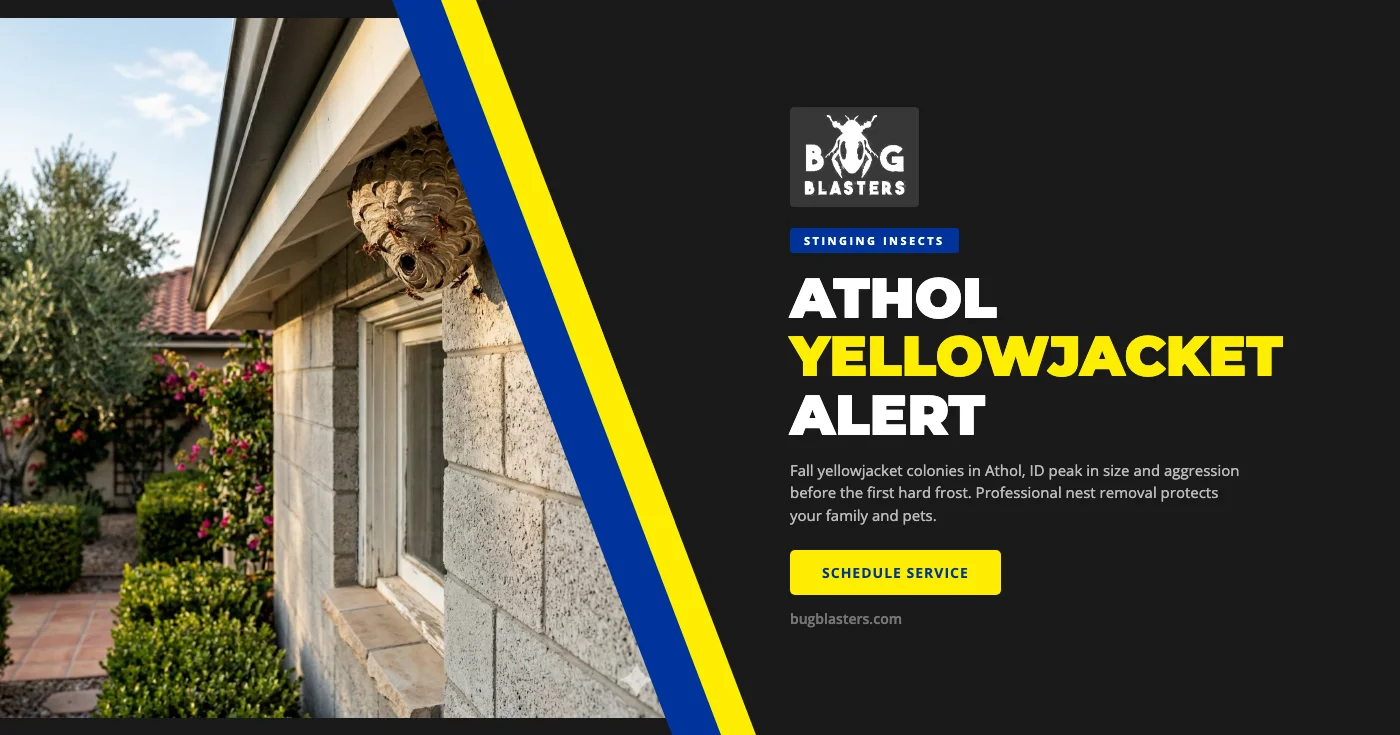
Aerial paper nests. A smaller share of North Idaho yellowjackets (along with bald-faced hornets) build football-shaped paper nests in trees, on eaves, or on the underside of decks. These are the textbook nests most Athol, ID homeowners picture — but ground and cavity colonies vastly outnumber them.
Sudden appearance at food sources. Even without seeing a nest, a sudden late-summer influx of yellowjackets at outdoor meals, at pet-food bowls, at garbage cans, or around ripening fruit is a reliable sign that a colony has matured somewhere within a few hundred yards of the Athol, ID property. Foraging range in fall commonly stretches to about 1,000 feet from the nest entrance.
Why Late-Season Yellowjackets Are More Aggressive Than Spring Nests
Homeowners in Athol, ID who watched their kids play near the same fence line in June are often shocked at how differently the same yard behaves in September. That shift is not imagined and it is not random — three biological forces converge in late season to make yellowjackets meaningfully more aggressive.
Colony population is at its annual maximum. A June colony with 200 workers reacts to a disturbance with a handful of guards. A September colony with 4,000 workers reacts with an angry cloud. The stings-per-incident ratio scales directly with worker count, which is why fall yellowjacket incidents in Athol, ID are so frequently multi-sting events.
Food scarcity flips them into scavenger mode. Yellowjackets spend the early summer hunting other insects — caterpillars, flies, spiders — to feed protein to the developing larvae. As fall approaches and the last brood matures, that in-nest larval demand drops off. Workers, meanwhile, still need to eat, and they switch aggressively to carbohydrates: fallen fruit, sugary drinks, sports drinks, hummingbird feeders, garbage. This is the season when a yellowjacket will land on the rim of a soda can, crawl inside, and sting a lip on the way out. The Utah State University Extension describes this late-season scavenging shift as the single biggest driver of human-yellowjacket conflicts.
New queens are being produced. Late in the cycle, the founding queen shifts her egg-laying pattern to produce new queens and males rather than more workers. The colony instinctively becomes more defensive of the reproductive brood, and pheromone signaling amps up the guard response. Every Athol, ID colony we treat in late September is protecting an investment it will never see mature — and the workers behave accordingly.
The practical result on an Athol, ID property is that a nest a family walked past dozens of times in July might, by the last week of September, be one bad step away from a serious multi-sting incident. Yellowjacket venom can produce systemic allergic reactions even in people with no prior sting history, and yellowjacket stings are among the leading causes of insect-triggered anaphylaxis in the United States.
What Happens to Yellowjackets When Athol Temperatures Drop
Athol, ID sits above 2,300 feet in Kootenai County, and the first hard freeze typically arrives sometime between mid-October and early November. That freeze is the natural endpoint of the yellowjacket year in the area — but the way the colony ends is less tidy than most homeowners assume, and the timing has real consequences for how the season plays out.
Once nights dip into the 40s, the founding queen stops laying and eventually dies inside the nest. Newly produced queens and males leave the nest, mate on the wing, and the fertilized new queens disperse to overwintering shelter — hollow logs, loose bark, rock crevices, sheds, wood piles, and occasionally the wall voids and attics of Athol, ID homes. Every new queen is a potential nest for next spring, and the biggest colonies produce hundreds of them. The parent colony's workers keep foraging aggressively for the last warm days, get slower as nights cool, and eventually die within the nest or in the surrounding landscape.
Two things follow from that biology. First, an untreated fall colony does not "go away on its own" in any useful sense — it produces the next generation of queens before it dies, seeding the property (and often the neighboring properties) for another round the following year. Second, the treatment window matters. A colony hit professionally in mid-September stops producing new queens for that season; a colony left alone until the freeze has already done its reproductive work by the time cold weather arrives.
Professional Yellowjacket Nest Removal for Athol, ID Homeowners
Every fall we get calls from Athol, ID homeowners who tried a can of wasp spray on a ground nest first and are now looking for a professional after a bad reaction from the colony. There is a reason retail sprays fail so often on late-season nests.
Aerosol sprays are engineered for a small paper-wasp nest at close range on a flat surface — the exposed umbrella nest under an eave. That is a very different target from a 4,000-worker ground colony with an entrance leading down a rodent burrow into a chamber the size of a basketball. A retail spray hits the workers at the entrance, kills a few dozen, and drives the rest deeper into the burrow — or, in wall-void colonies, through the interior wall into the living space.
A professional yellowjacket treatment on an Athol, ID property looks fundamentally different. Our team identifies the exact nest location and orientation before any product is applied, chooses a treatment window at dusk or before dawn when the vast majority of the colony is inside, and uses a professional-grade dust or foam that workers carry deep into the nest chamber. For ground colonies we treat the burrow itself; for wall-void colonies we treat through the exterior entry point and hold the interior sealed until the colony is fully down; for aerial paper nests we use extension gear and protective equipment that keeps the work outside the colony's defensive radius.
Our full Yellowjacket Control program includes species confirmation, entry-point sealing recommendations, a 72-hour verification return to confirm colony collapse, and a walk-through of the burrow, soffit, and outbuilding conditions that attracted the queen in the first place. Many Athol, ID homeowners pair yellowjacket work with our broader General Pest Control program in the fall, since the same access points that let a stinging colony establish are usually the same access points that fall rodents and overwintering insects use to move indoors.
When to Call Bug Blasters for Stinging Insect Control in Athol, ID
If you're seeing steady yellowjacket traffic at a hole in the lawn, at a soffit or fascia joint, at a shed or outbuilding, or inside the walls of your Athol, ID home, that is the right time to reach out to us — well before the first hard freeze, ideally, and always before someone in the family gets stung. Our team knows the Athol area, the roads out toward Farragut State Park, the Bayview stretch along Lake Pend Oreille, the properties tucked up above Highway 54, and the mix of rural acreages and closer-in Athol, ID neighborhoods that shape how yellowjacket colonies establish across our service area.
A yellowjacket control Athol ID visit from Bug Blasters starts with a full property inspection — identifying every active colony, mapping the flight paths, and confirming species so we can match the treatment to the biology. From there we build a plan around the findings, treat at the optimal window, verify collapse, and give you clear guidance on entry points to seal for next spring. Late-season yellowjackets don't get better on their own, and every week deeper into fall raises the risk of a serious sting incident. If yellowjackets are on your mind, reach out to Bug Blasters — we will help your family get back to peace of mind in the yard before winter settles in over the Athol, ID area.