
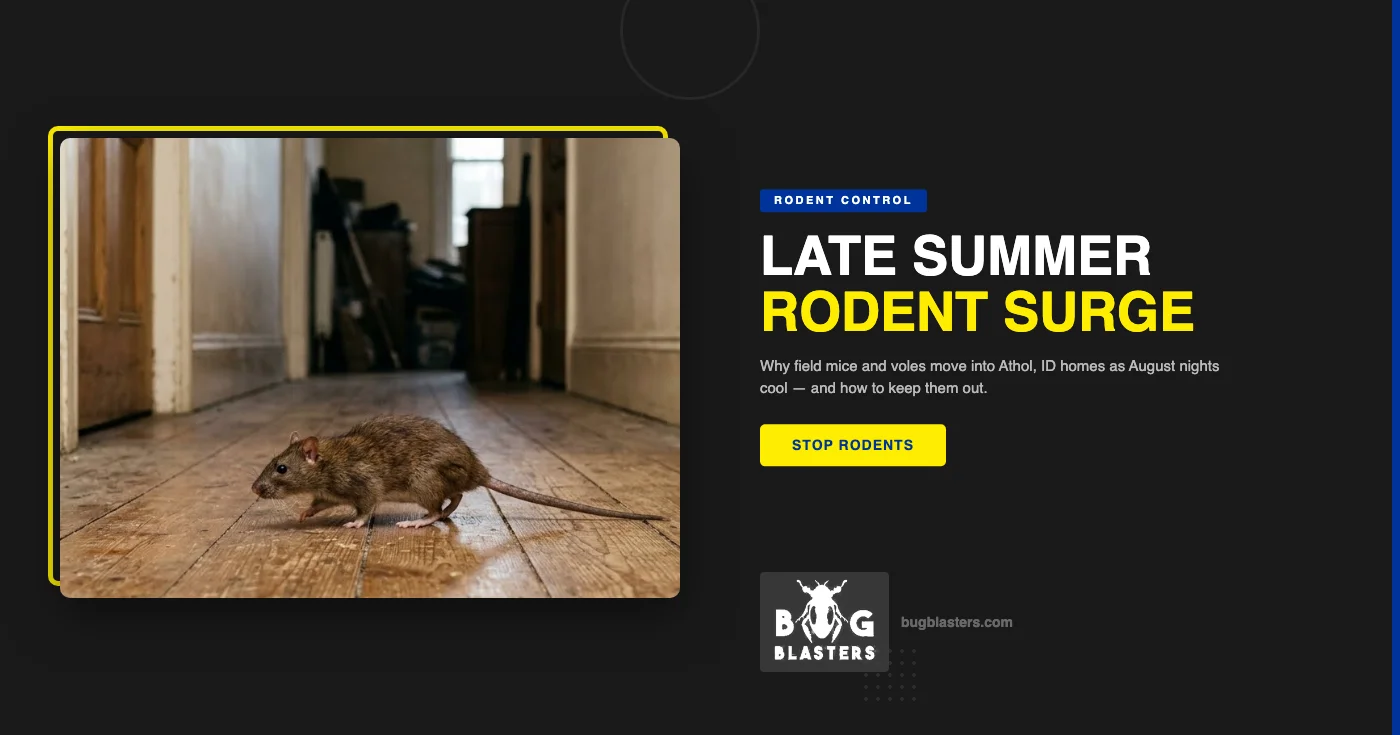
Late-Summer Rodent Surge in Athol, ID: Why Field Mice and Voles Start Moving Toward Homes in August
If you value the rural quiet around Athol, ID, you may have already noticed a familiar late-summer pattern: mice growing bolder around the house, voles carving runways across the lawn, and more activity around sheds and outbuildings as August wears on. You're not imagining it. Every year across Kootenai County, rodent pressure climbs sharply in late summer, and it follows a predictable seasonal rhythm. At Bug Blasters, we field a wave of rodent calls from Athol, ID homeowners this time of year, and we want you to understand what's driving the surge — and what you can do before the problem follows you indoors this fall.
Why Rodent Activity Climbs in Athol, ID During Late Summer
Two forces overlap in late summer to push rodent numbers up around Athol, ID: biology and environment. Through the warm months, deer mice, house mice, and voles breed prolifically. A single female mouse can produce several litters in a season, so by August the local population has reached its annual peak — there are simply more rodents on the landscape than at any other time of year.
At the same time, the outdoor food supply that sustained them starts to thin. Gardens finish, crops come off the fields, and the wild grasses that went to seed begin to dry out. As that easy forage disappears, rodents range wider and grow bolder, searching for reliable food and shelter. In a rural community like Athol, ID — ringed by pasture, woodlots, and open field — that search leads them straight toward homes, barns, and feed storage. The University of Idaho Extension notes that rodent populations across the region run highest in late summer and early fall, coinciding with peak breeding and the first cool nights. It's a cycle that repeats reliably every year in Athol, ID.
Deer Mice, Voles, and House Mice: North Idaho's Late-Summer Rodents
Not every rodent behaves the same way, and knowing which one you're dealing with in Athol, ID shapes the response. These are the species our team encounters most this time of year:
Deer Mouse (Peromyscus maniculatus): The most common wild mouse in North Idaho, the deer mouse is easy to recognize by its two-tone coloring — brown or tan on top, clean white on the belly and feet — with large eyes and ears. Deer mice favor fields, woodpiles, and outbuildings, which makes rural Athol, ID properties ideal habitat. They're also the primary carrier of hantavirus, which we'll cover below.
House Mouse (Mus musculus): Uniformly gray-brown with a musky odor, the house mouse is the classic indoor invader. It's a remarkable contortionist — an adult can squeeze through a gap as small as a quarter inch, roughly the width of a pencil. Once inside an Athol, ID home, it nests in walls, cabinets, and attics.
Voles (Microtus montanus and related species): Often called field mice or meadow mice, voles are heavy-bodied ground-dwellers with short legs, short tails, and small rounded ears, measuring about four and a half to five and a half inches. Rather than climbing into your home, voles build surface runways and shallow burrows across lawns, pasture, and the ground along foundations. They feed on roots, stems, grass, seeds, and bulbs, and they can girdle young trees and shrubs by chewing the bark at the base. On rural Athol, ID properties, voles readily push into crawl spaces, garages, and outbuildings as their outdoor food thins.
Norway Rat (Rattus norvegicus): Less common than mice but a real concern around barns, coops, and feed storage, the Norway rat burrows near foundations and outbuildings and can fit through a gap of about half an inch. Where livestock feed and grain are present on Athol, ID acreage, rats are worth watching for.
How Cooling August Nights Push Rodents Toward Homes and Outbuildings
The mechanism behind the late-summer move indoors is simple once you understand it. Rodents are drawn to three things: warmth, a steady food source, and sheltered harborage. Cooling nights are the trigger that sets the migration in motion around Athol, ID.
Athol sits at roughly 2,300 feet in elevation, and the overnight temperature swing this time of year can be dramatic. An afternoon that reaches the mid-80s can fall into the 40s or low 50s by dawn as August turns toward September. For mice and voles that spent the summer living in fields, woodpiles, and along foundation walls, that overnight chill is a signal to seek warmer ground. They follow heat gradients and scent trails, and the warmth radiating from a home, a heated shop, or a well-insulated barn in Athol, ID becomes an obvious target.
This warmth-seeking behavior lines up precisely with the outdoor food shortage. Just as rodents start looking for shelter, your pantry, pet food, birdseed, and stored garden harvest become the most reliable meals around. Once a single mouse finds a gap and gets inside an Athol, ID home, it leaves scent trails that guide others to the same opening — which is why a small problem can escalate quickly if it isn't addressed early.
Rural Athol Properties: Sheds, Woodpiles, and Barns as Rodent Magnets
Rural living is part of what makes Athol, ID special, but acreage also comes with more rodent harborage than a typical city lot. Sheds, barns, chicken coops, detached garages, crawl spaces, woodpiles, and equipment storage all give mice and voles the cover they crave. A few adjustments around the property go a long way toward reducing the pressure.
Move woodpiles away from structures. Firewood stacked against a shed or the side of the house is prime deer mouse and vole habitat. Relocate woodpiles at least 20 feet from buildings in Athol, ID and elevate them off the ground so rodents can't nest underneath undisturbed.
Lock down feed and seed. Livestock feed, birdseed, and pet food left in paper or thin plastic bags are an open buffet. Store everything in metal or heavy-duty plastic bins with tight-fitting lids — one of the single most effective steps for rural Athol, ID properties.
Clear a perimeter. Tall grass, weeds, and dense brush against the foundation give voles cover for their runways and give mice a bridge to entry points. Mow close, trim vegetation back from the siding, and keep a dry, cleared strip around the base of the home and outbuildings.
Cut the clutter. Cardboard boxes, old furniture, and stacked items inside sheds and garages become nesting sites. Store belongings off the floor in sealed bins and keep those spaces organized so activity is easier to spot early.
Health Risks Rodents Bring to Athol Families and Pets
Beyond the nuisance, rodents carry genuine health concerns for Athol, ID families — which is the biggest reason to act before an infestation takes hold. The deer mouse so common on North Idaho acreage is the primary carrier of hantavirus, a rare but serious illness. According to the Centers for Disease Control and Prevention, the virus is present in an infected deer mouse's urine, droppings, and saliva, and it can become airborne when a nest or droppings are disturbed — for example, by sweeping or vacuuming dry material. Breathing in those particles is the most common route of infection.
The CDC's guidance matters for anyone cleaning up rodent evidence in an Athol, ID home or outbuilding: rather than sweeping or vacuuming dry droppings, thoroughly wet the contaminated area with a disinfectant first, seal gaps that let rodents in, set traps to reduce the population, and remove the food sources drawing them. Taking those steps protects your household's well-being during cleanup.
Hantavirus isn't the only risk. Mouse and rat droppings and urine contaminate food, counters, and stored goods, and rodents can carry salmonella and other pathogens. Their dander and droppings also aggravate allergies and asthma. Pets face their own exposure — rodents bring fleas and ticks with them, and pets can be poisoned if they reach over-the-counter rodent baits, which is one more reason to rely on targeted, professionally placed methods. Finally, rodents gnaw constantly: chewed wiring in an Athol, ID barn or crawl space is both a structural and a fire hazard.
Early Signs of a Rodent Problem Before Fall
Catching rodents early is far easier than clearing an established infestation, so it pays to know the warning signs around your Athol, ID property before fall sets in.
Indoors, watch for: small dark droppings along walls, in drawers, and in pantry corners; gnaw marks on food packaging, wood, and wiring; and greasy rub marks along baseboards and beams where mice travel the same routes. Scratching, scampering, or gnawing sounds in walls, ceilings, or the attic after dark are a common early tip-off, as are nests of shredded paper, insulation, or fabric tucked into hidden spots. A persistent musky odor often points to house mice, and a pet fixated on a particular wall or appliance is frequently onto something.
Outdoors, look for vole activity: narrow surface runways worn through the lawn, roughly one to two inches wide; small burrow openings in the turf; and chewed bark at the base of young trees and shrubs, sometimes with plants that suddenly wilt or die. On rural Athol, ID lots, these outdoor signs are often the first clue that rodent numbers are building and starting to press toward the house and outbuildings.
How Bug Blasters Handles Rodent Control in Athol
We've served Athol, ID and the wider Kootenai County area for years, and late-summer rodent control is one of the services we deliver most consistently each season. Our approach is thorough, and it's built around the realities of rural North Idaho properties.
Every job starts with a full inspection, inside and out. We identify which species is active, locate entry points and harborage, and map the runways and nesting areas around the home, shed, barn, and crawl space. From there, our Rodent Control program focuses on exclusion first — sealing the quarter-inch gaps mice exploit and the half-inch openings rats use, from crawl-space vents and utility penetrations to door thresholds and foundation cracks.
Alongside exclusion, we use targeted trapping and control placed precisely in the zones where rodents are active, rather than broadcasting product across the property. On Athol, ID acreage with pets and livestock, that precision matters. We also walk you through the harborage changes that make the biggest difference on your specific lot — woodpile placement, feed storage, vegetation, and clutter — so the results hold.
Because rodent pressure is tied to the wider pest picture, many Athol, ID homeowners pair rodent work with our General Pest Control program, which manages the insects and conditions that draw rodents in the first place. Our goal is straightforward: to give Athol, ID families genuine peace of mind heading into fall, not just a temporary dip in activity. If you're already seeing mice, voles, or the early signs above around your Athol, ID home, reach out to Bug Blasters and let our team put together a plan before the fall rush begins.