
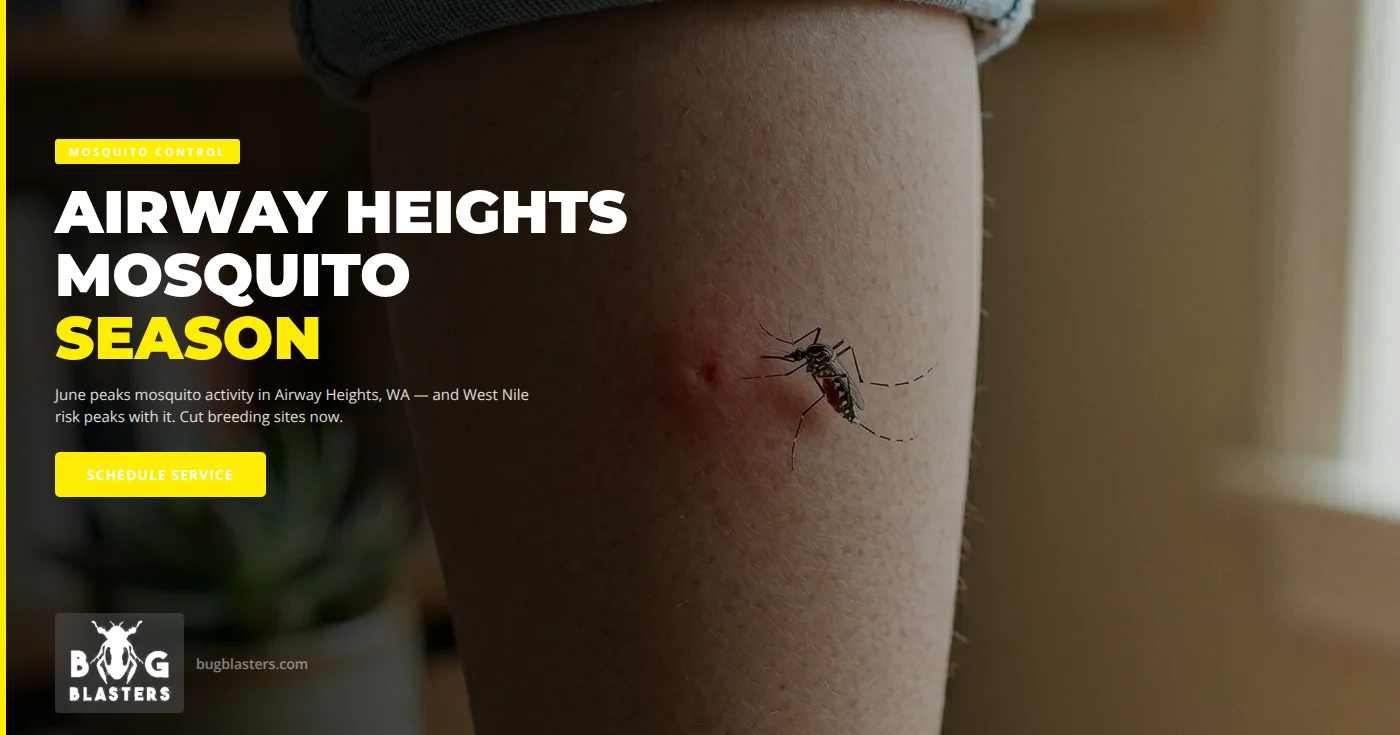
If you live in Airway Heights, WA, you have probably already swatted at a mosquito on the back patio this season. June is the month our team at Bug Blasters starts fielding calls from Airway Heights homeowners who fired up the grill at dusk and walked back inside covered in bites. The Pacific Northwest reputation for a mild bug season does not really apply once warm afternoons, irrigation runoff, and lingering snowmelt come together on the Spokane plateau — and mosquito control in Airway Heights, WA becomes a public-health question once West Nile Virus enters the picture.
At Bug Blasters we serve Airway Heights along with Spokane, Spokane Valley, Liberty Lake, Cheney, and the rest of the Inland Northwest. This guide covers why mosquito populations jump in June, what West Nile Virus looks like locally, the breeding spots we keep finding, how to run a standing-water audit, and where professional treatment fits in.
Why Mosquito Activity Surges in Airway Heights Each June
Airway Heights sits on the western edge of the Spokane metro at about 2,400 feet, ringed by irrigated cropland, the Spokane River drainage, scab-rock potholes, and the seasonal wetlands along Deep Creek and the Hangman/Latah Creek headwaters. That landscape is excellent mosquito habitat once nighttime lows climb above 50°F and daytime highs sit in the 70s and 80s — exactly what June delivers on the plateau.
Three things change in June. Overwintering eggs and adults finally have warm enough water to develop — larvae that needed ten days to mature in May can finish in four or five days. Irrigation kicks in across area lawns, hayfields, and roadside ditches, leaving low spots and clogged catch basins full of warm, nutrient-rich water — prime Culex larval habitat. And adults that emerged in May begin their first full reproductive cycle, with a single female laying 100 to 300 eggs at a time.
The result is a population curve that climbs almost vertically through June and stays elevated until the first hard frost. Homeowners who treated proactively in May see a measurable difference; those who waited are typically chasing a population that has already established several generations on the property.
West Nile Virus in Eastern Washington: What You Need to Know
West Nile Virus arrived in Washington in the early 2000s and is now an established part of the Eastern Washington summer. According to the Washington State Department of Health, the state averages dozens of mosquito detections each year, with the heaviest activity in the Columbia Basin counties just to our west — Yakima, Benton, Franklin, and Grant — where the primary vector, Culex tarsalis, thrives in irrigated agriculture.
Spokane County sits at the eastern edge of that activity zone. Detection in local mosquito pools varies year to year, but the conditions that drive transmission — warm summers, irrigated landscapes, and a healthy Culex tarsalis population — are all present on the Spokane plateau. The Spokane Regional Health District has confirmed positive mosquito pools, infected horses, and a small number of human cases over the past decade. The risk is not constant, but it is real, and it is highest from late June through early September.
Most people infected with West Nile Virus have no symptoms. About one in five develops a fever, headache, and body aches. Roughly one in 150 develops a serious neurological illness, with adults over 60 at highest risk. There is no vaccine and no specific antiviral treatment — prevention is the entire strategy.
Common Mosquito Breeding Spots in Airway Heights Backyards
Mosquitoes do not need much water to breed — a bottle cap can support larvae. After hundreds of inspections across the West Plains, our technicians keep finding the same productive breeding spots in residential yards:
- Clogged gutters and downspout extensions — pine needles and cottonwood fluff trap shallow pools that warm fast in the afternoon sun.
- Plant saucers, decorative pots, and birdbaths. The water at the bottom of a ceramic planter is a textbook Culex nursery.
- Tarp folds and equipment covers over boats, RVs, woodpiles, and patio furniture — a fist-sized depression can produce hundreds of adults.
- Children's toys, wheelbarrows, and 5-gallon buckets left upright after a rain.
- Corrugated drain pipe, french-drain outlets, and low spots in the lawn where sprinkler overspray pools for more than three days.
- Untended swimming pools, hot tubs, and stock-watering troughs. Properties between renters can produce an enormous population in a single month.
- Tire swings, old tires, tree holes, and rotted stumps in mature yards along the river bluff.
Two patterns are worth flagging for the West Plains specifically. Irrigation runoff into roadside ditches and culverts is a major off-property source — you can do everything right on your own land and still get bitten because the neighbor's pasture ditch is producing. And livestock troughs and seasonal stock-watering ponds on small acreages around Airway Heights, Medical Lake, and Cheney are consistent Culex tarsalis sources — the mosquitoes most likely to be carrying West Nile Virus.
Standing Water Audit: How to Eliminate Mosquito Habitat
The most effective mosquito control in Airway Heights, WA starts with a thorough standing-water audit. Walk your property with a notepad on a Saturday morning, ideally a day or two after a rain or full irrigation cycle. The goal is to eliminate water that sits longer than three days, roughly the floor for Culex egg-to-larva development at June temperatures.
- Drain and dump. Empty buckets, tip wheelbarrows, drill drainage holes in the bottoms of plant saucers, and tighten or replace tarps that pool water. Drain and refresh birdbaths weekly and pet water bowls daily.
- Clear and re-slope. Clean gutters, extend downspout outlets at least four feet from the foundation, and re-grade low spots in the lawn where sprinklers consistently pool.
- Cover or screen. Tightly cover rain barrels and cisterns with fine mesh and snug-fitting lids on stock tanks where possible.
- Treat the water you cannot remove. Permanent water features, retention ponds, untended pools, and large stock tanks call for Bacillus thuringiensis israelensis (Bti) larvicide briquettes — sold at most hardware stores as "mosquito dunks." Bti is a naturally occurring soil bacterium that targets mosquito larvae and is approved by the U.S. EPA for use in water sources that contain fish, livestock, and pets.
One audit is not enough. Irrigation runoff, thunderstorms, and warm weather create new standing water all summer. Plan on a quick walk-around once a week from mid-June through Labor Day.
Effective Mosquito Prevention Tactics for Local Yards
Habitat reduction is the foundation, but even the cleanest property in Airway Heights will see mosquitoes that flew in from a neighboring lot, an irrigation ditch, or a wetland edge. Personal bite prevention and adult-mosquito reduction round out the strategy.
- Use an EPA-registered repellent. The CDC recommends DEET, picaridin, IR3535, oil of lemon eucalyptus (OLE), or para-menthane-diol (PMD).
- Treat outdoor clothing with permethrin. A 0.5% spray applied to shirts, pants, socks, and tent fabric protects through multiple wash cycles. Not for use directly on skin.
- Schedule outdoor work around peak biting hours. Culex mosquitoes are most active from dusk through the first few hours after sunrise.
- Repair window and door screens. A torn corner on a sliding-door screen is enough to seed an indoor mosquito problem on a warm June night.
- Run a fan on the patio. Mosquitoes are weak fliers, and a box fan on a covered deck is a surprisingly effective deterrent during outdoor dinners.
- Maintain landscaping. Mow tall grass, trim back overgrown shrubs against the house, and prune low-hanging branches. Adult mosquitoes rest in shaded, humid vegetation during the day.
- Consider a recurring barrier treatment. A residual product applied to the underside of leaves and shaded resting sites can knock down the adult population for three to four weeks at a time.
These tactics layer well with our recurring residential pest control service — a single point of contact across the full warm-weather pest season.
When Professional Mosquito Treatment Makes Sense
Not every property needs a professional treatment. A small city lot with no standing water, no nearby wetlands, and a willing-to-DIY homeowner can often handle the season with habitat reduction and repellent alone. Professional treatment becomes the right call when:
- The property backs onto irrigated cropland, pasture, an irrigation ditch, a retention pond, or a wetland edge — common around Airway Heights, Medical Lake, and the Spokane River corridor.
- An outdoor event is scheduled — a wedding, graduation party, or backyard tournament — and bites would derail it.
- Anyone in the household is over 60 or has an underlying condition that raises their West Nile Virus risk.
- The property has horses, which are highly susceptible to West Nile Virus.
- Habitat reduction and repellents have not produced a noticeable drop in bites after two or three weeks of consistent effort.
Professional treatment in our hands means an inspection that identifies on-property breeding sites and adult resting habitat first, a targeted residual application to vegetation and shaded structural surfaces, and larvicide treatment of any standing water that cannot be eliminated. Visits are scheduled every three to four weeks so the residual overlaps and the larvicide stays current.
How Bug Blasters Protects Your Family All Summer
Our approach to mosquito control in Airway Heights, WA combines inspection, source reduction, larvicide where appropriate, and a targeted adulticide barrier — applied on a schedule that matches the local population curve. Inland Northwest mosquito season runs from June into October, and that is the window our recurring program covers.
- Initial inspection. A technician walks the property with the homeowner, flags standing-water sources and resting habitat, and recommends specific source-reduction steps.
- First treatment. Targeted residual application to the underside of foliage, shaded foundation areas, and fence lines, with Bti briquettes in any standing water that cannot be drained.
- Recurring service. Re-treatment every three to four weeks keeps the residual fresh as it weathers and as new adults emerge from off-property sources.
Mosquito control is one piece of a broader pest picture for Airway Heights homes. Carpenter ants, wasps, spiders, and rodents all run their own seasonal cycles on the West Plains, and our recurring service is built to cover the full warm-weather pest load on a single visit.
Frequently Asked Questions About Mosquito Control in Airway Heights, WA
When does mosquito season start in the Spokane area?
The first adult mosquitoes appear in late April or early May on the Spokane plateau, but populations stay low through the cool nights of May. The real surge begins in June once nighttime lows climb above 50°F and irrigation kicks in, and elevated activity continues through September into October.
How serious is the West Nile Virus risk in Airway Heights?
West Nile Virus is established in Eastern Washington and detected in Spokane-area mosquito pools in most years. Most infections are asymptomatic, but about one in 150 cases develops a serious neurological illness, with the highest risk for adults over 60. There is no vaccine and no specific treatment, which is why prevention is the entire strategy.
Will a single yard treatment fix my mosquito problem for the summer?
No. Residual products weather over three to four weeks, and adult mosquitoes constantly fly in from neighboring properties, ditches, and wetlands. A recurring program scheduled to match the residual interval is what produces a consistent reduction in bites.
What is the single best thing I can do this weekend?
Walk the property with a notepad and eliminate every spot of standing water that has been sitting for more than three days. Drain it, drill holes in plant saucers, clean gutters, and place a Bti briquette in anything you cannot drain. That one audit shuts down the on-property breeding cycle.
June is the window where one well-timed plan prevents three months of compounding bites and reduces real West Nile Virus exposure. To schedule a property inspection or ask about mosquito control in Airway Heights, WA, reach our team through our contact page. We serve Airway Heights, Spokane, Spokane Valley, Liberty Lake, Cheney, Post Falls, Coeur d'Alene, and the rest of the Inland Northwest.