
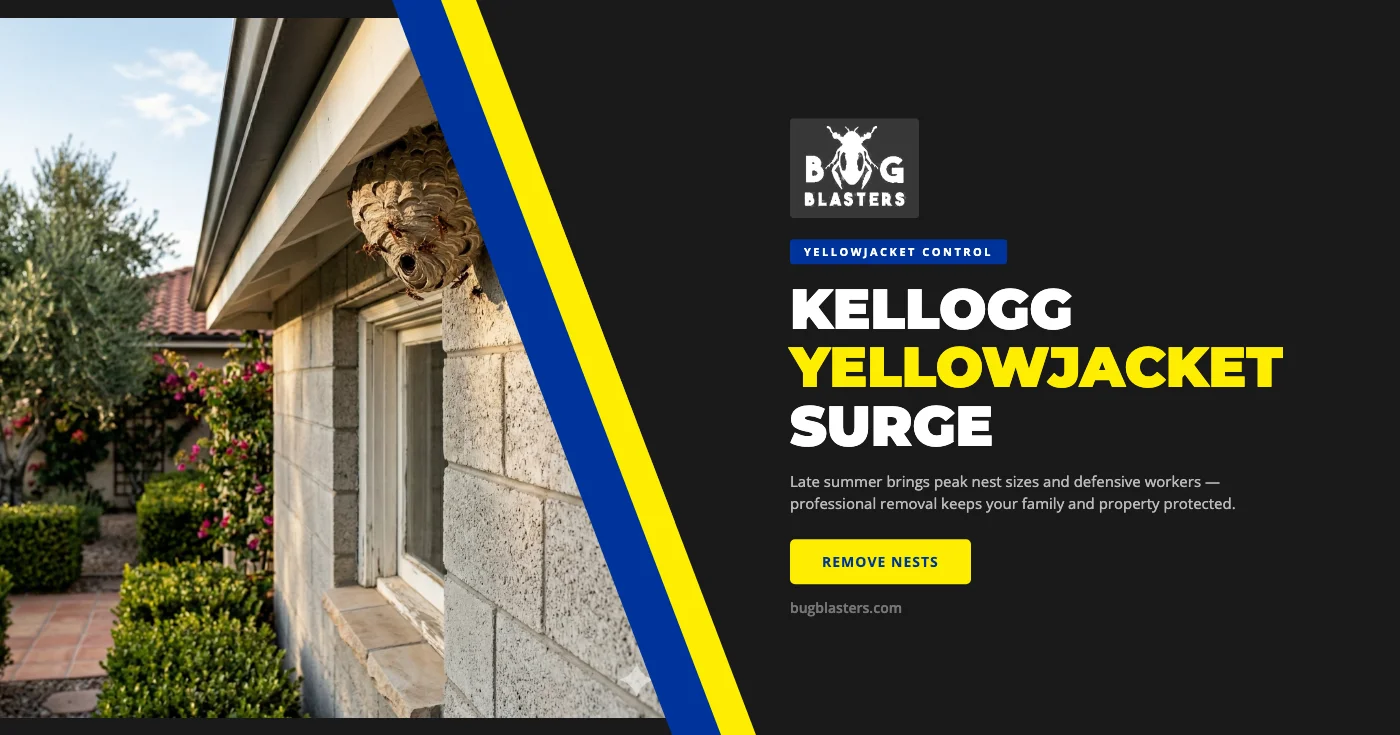
Every August around Kellogg, ID, our phones in the Silver Valley fill with the same call — a hole in the lawn boiling with yellowjackets, a football-sized paper nest under an eave, or a steady stream of wasps disappearing into a siding gap. If you're searching for stinging insect control Kellogg ID right now, you're dealing with the exact stretch of the year when yellowjacket colonies in North Idaho hit their annual peak. At Bug Blasters, we work Kellogg and the surrounding Shoshone County area through this window every summer, and the difference between a July call and a late-August call is dramatic.
Why Late Summer Is Peak Yellowjacket Season in North Idaho
Every yellowjacket colony in North Idaho begins the same quiet way. A single overwintered queen emerges in April or May, finds a sheltered spot — an abandoned rodent burrow, a corner of a soffit, a hollow tree in the timber above Kellogg, ID — and lays her first batch of eggs alone. Through May and June the colony is small and easy to miss.
By late July and into August that quiet start has flipped into a full-throated colony. The University of Idaho Extension notes that yellowjacket populations across the region peak in late summer and early fall, when colonies have grown for months and workers forage hard to raise the next generation of queens. By August, a single Kellogg, ID ground nest can contain two to five thousand workers, and bald-faced hornet paper nests around the Silver Valley regularly reach the size of a soccer ball before the first freeze.
A colony you didn't notice at the Fourth of July parade is the colony you can't ignore by Labor Day. Our service window for stinging insects across North Idaho is short — roughly mid-June through October — and every week the average colony is measurably larger and more defensive than the week before. August is the moment to stop hoping the nest will thin out on its own and get a professional eye on the property.
Yellowjacket vs. Wasp vs. Bee: What Kellogg, ID Residents Need to Know
The single most important call on any Kellogg, ID stinging insect job is species identification. Treatment for each looks completely different, and getting the ID wrong is the fastest way to end up with a homeowner in the emergency room and the colony still intact. Here is what we look for on inspections around Kellogg, ID:
Western yellowjackets. Short, stocky body about half an inch long with bright yellow-and-black banding. Nests almost always concealed — underground in old rodent burrows, inside wall voids, behind soffit vents, under decks. What you see is a steady two-way stream of workers entering and leaving a single small opening. The western is the most common species we treat around Kellogg, ID, and the German yellowjacket — a more defensive species that prefers structural voids — turns up often enough to matter.
Paper wasps. Slimmer bodies with long legs that dangle in flight, brown to reddish-brown with yellow markings. Nests are the open, umbrella-shaped honeycombs hanging from eaves, inside grills and mailboxes, and tucked into shutter corners. Colonies stay small (20 to 100 wasps) and are less defensive than yellowjackets unless the nest is directly disturbed.
Bald-faced hornets. A species of large yellowjacket, black with white facial markings, about three-quarters of an inch long. Build the famous gray, football-shaped paper envelope nests hanging from tree branches, eaves, and outbuildings around the Silver Valley. Highly defensive, but the nest is fully visible.
Honeybees. Fuzzy, golden-brown body about half an inch long with a rounder shape than a yellowjacket. Honeybees are pollinators; wherever possible we refer swarm calls in Kellogg, ID to a local beekeeper for relocation rather than treating.
The confusion that trips up Kellogg, ID homeowners most often is yellowjacket versus paper wasp. Paper wasp nests are visible, small, and manageable. Yellowjacket nests are hidden and huge. If you see a steady flight path in and out of a hole or gap without a visible nest, that is a yellowjacket colony every single time.
Warning Signs of a Dangerous Nest on Your Kellogg Property
You don't have to spot the nest itself to know a colony is on your Kellogg, ID property. Yellowjackets and hornets reveal themselves in a handful of predictable ways, and catching those signals early is what keeps a summer inspection from turning into a September emergency call. The patterns we hear about most from Kellogg, ID homeowners:
A steady, two-way stream at a single point. Workers entering and leaving the same hole in the lawn, gap in the siding, crack along the foundation, or corner of a soffit from dawn to dusk. One worker is a passerby; a steady flight path is a colony.
Dozens of yellowjackets at sweet drinks and pet food. Late-summer sugar foraging pulls yellowjackets to soda cans, fruit bowls, pet food dishes, and open trash bins on Kellogg, ID back decks. If a mid-August barbecue turns into ten yellowjackets per soda can, a mature colony is nearby.
A worn flight corridor. Wasps flying the same line every day — between a tree along the Coeur d'Alene River corridor and a single corner of your Kellogg, ID home, for example — is a colony commuting between the nest and a food source.
A faint buzzing inside a wall or soffit. On a hot afternoon in the Silver Valley, a papery vibration audible through drywall or a soffit almost always means an active wall-void colony. That is not a job for a can of spray from town.
Pets fixated on a specific spot. Dogs and cats often locate a ground nest days before their owners do. If the family dog refuses to walk past one fence post or flower bed, watch that area from 20 feet and look for entry traffic.
An angry defensive burst during yard work. String-trimming, mowing, or even slamming a door triggering a sudden rush of yellowjackets from one area of your yard means the vibration is reaching a nest. Stop working the area, mark it clearly, and keep family and pets out until a professional identifies the location.
Why Yellowjacket Colonies Are Largest and Most Aggressive in August
Two things happen at once inside a yellowjacket colony in August that push both size and aggression to the annual peak on Kellogg, ID properties.
The first is simply time. A colony that started with one queen in May has now had roughly three months of continuous brood production. By mid-August it has cycled through several worker generations, and total population sits at or near its annual maximum — the two- to five-thousand-worker range we regularly encounter on Kellogg, ID inspections.
The second is a shift in what the colony is eating. Through spring and early summer, workers hunt caterpillars, spiders, and other soft-bodied insects for the brood; in return, the larvae secrete a sugary liquid the workers rely on. As the queen shifts to producing next year's reproductive brood, that in-colony sugar supply drops off sharply. Workers are hungry and switch to aggressive sugar scavenging outside the nest — which is why late-August yellowjackets around Kellogg, ID show up in force at your picnic and defend a spilled soda can like it belongs to them.
Kellogg's climate amplifies both trends. The Silver Valley sits at roughly 2,494 feet, and August highs near 78°F combined with cool 48°F overnight lows and low humidity give workers ideal flight and foraging conditions. Long summer daylight past 9:00 PM extends the workday and pushes colony growth beyond what shorter-day climates produce.
DIY Nest Removal Risks and Why Professional Removal Is the Smarter Choice
Hardware-store wasp sprays are designed for one specific job — a small, visible paper-wasp nest under an eave, hit at dusk from a stable distance. They are not designed for a mature August yellowjacket ground colony on a Kellogg, ID property that may contain three thousand workers, half of them inside the burrow when the spray hits. Every summer we get called to fix the same DIY failure patterns:
Surface-spraying a hidden colony. Visible workers near the entrance die instantly. Thousands deeper in the void are unaffected, pick up alarm pheromones, and pour out aggressively. Multi-sting attacks on Kellogg, ID homeowners at this stage are the most common DIY injury we see in August.
Pouring gasoline, bleach, or boiling water into a ground nest. The University of Idaho Extension explicitly warns against these methods. They are environmentally damaging, ineffective on any real colony, and dangerous to the person attempting them. Gasoline poured into the soil around a Kellogg, ID home contaminates the ground for years.
Sealing the entrance. Blocking a wall-void entry hole traps thousands of stressed workers inside the structure. They chew a new exit — often directly into the living space — within a day or two.
The medical side is what most Kellogg, ID homeowners underestimate. Yellowjackets, unlike honeybees, can sting many times in a single attack, and a disturbed mid-summer ground colony can deliver dozens of stings in under a minute. For anyone with a known insect-sting allergy, or for children and elderly family members, the risk of a DIY August attempt is simply not worth the outcome. Professional treatment hits the entire colony at once, at the right time of day, with the right products for the species.
How Bug Blasters Handles Stinging Insect Problems in Kellogg, ID
Our stinging insect protocol for Kellogg, ID and the Silver Valley is built around three things — accurate species identification, the right product applied at the right time of day, and follow-up verification that the colony is actually dead. A typical Kellogg, ID yellowjacket or wasp call looks like this:
Every job starts with a full-property inspection. Yellowjackets and hornets often have one obvious nest plus a satellite or two on the same lot — a paper wasp start in a shutter, a second ground colony along a back fence, a hornet nest in a tree we hadn't spotted from the road. We map every active nest before treatment begins, so we're not back the following week for the one we missed. Species confirmation comes next — western yellowjackets, German yellowjackets, paper wasps, and bald-faced hornets each get a different product and application strategy.
Application is timed to dusk or pre-dawn whenever possible. Foragers return to the nest at night, and a treatment scheduled for peak nest occupancy hits the vast majority of the colony in a single visit — not just the workers that happen to be outside during the day. For a mature August colony on a Kellogg, ID property, that timing turns a two-thousand-worker nest into a one-visit job.
For ground colonies and wall voids we use a professional-grade dust that workers track deep into the nest, plus a residual at the entry point that catches any forager arriving after the initial treatment. For bald-faced hornet nests in trees or under high eaves around Kellogg, ID, we use extension equipment and protective gear that keep the work outside the colony's defensive radius, with knockdown at dusk and nest removal once activity has fully stopped.
Every job includes a 72-hour verification — we don't close the ticket until zero activity is confirmed at the entrance, and if a very large late-summer colony rebounds we re-treat at no charge. Before we leave, we walk you through the rodent burrows, soffit gaps, and outbuilding access points that attracted this year's queen, so next April's queens have fewer options.
If you've been noticing a steady flight path into your siding, an active hole in the lawn, or a paper nest under an eave around your Kellogg, ID home, reach out to Bug Blasters. Our Wasp Pest Control team handles yellowjackets, paper wasps, and bald-faced hornets across the Silver Valley, and we'll build a plan that gives your family real peace of mind before the fall aggression window peaks.