
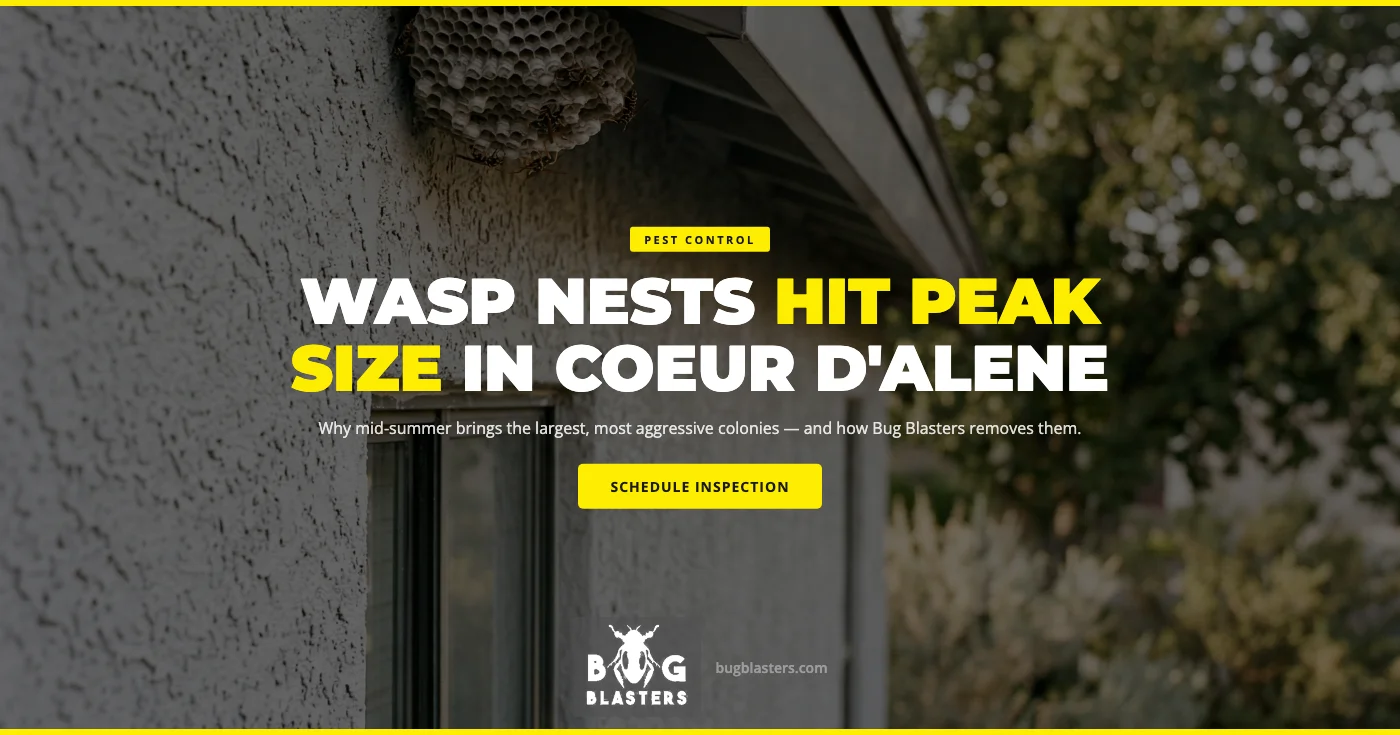
If you've been hearing a steady hum from inside the wall, watching wasps disappear into a hole in the lawn, or finding a paper nest the size of a softball under your eaves, you're not alone in Coeur d'Alene. Every June through September our phones in North Idaho fill with the same call — and the colonies behind those calls are bigger right now than they will be at any other point in the year. If you're searching for wasp control coeur d'alene, this guide is for you. We'll walk through why mid-summer is when wasp and yellowjacket nests hit peak size in our area, how to tell what you're actually dealing with, and what professional removal looks like at Bug Blasters.
Why Mid-Summer Brings Peak Wasp Activity to Coeur d'Alene
Every wasp and yellowjacket colony in North Idaho starts the same way. A single overwintered queen emerges in April or May, finds a sheltered spot — a hollow log, an abandoned rodent burrow, the inside of a soffit return, a corner of a deck joist — and lays her first batch of eggs alone. For the first six to eight weeks, the colony is small and easy to miss. A few dozen workers tend the queen's first brood and that's it.
By the second half of summer, that quiet start has flipped into a full-throated colony. According to the University of Idaho Extension wasp and hornet control guide, yellowjacket numbers in our region peak in late summer and early fall, when colonies have grown for several months and are foraging hard for the food they need to produce the next generation of queens. By August, a single Coeur d'Alene ground nest can contain thousands of workers, and bald-faced hornet paper nests around Hayden and Post Falls regularly reach the size of a soccer ball before fall.
That growth curve is why a colony you didn't notice in May becomes the colony you can't ignore in August. Our service window for wasps and yellowjackets in North Idaho is short — roughly mid-June through October — and every week of that window the average colony is measurably larger and more defensive than it was the week before.
Yellowjackets vs. Paper Wasps vs. Hornets: Identifying What's in Your Yard
The treatment for each of these stinging insects looks different, so the first job on every Bug Blasters call is identification. Here's what we look for on a Coeur d'Alene property:
- Western yellowjackets. Short, stocky body about half an inch long with bright yellow and black banding and a smooth thorax. Nests almost always concealed — underground in old rodent burrows, inside wall voids, behind soffit vents, under decks. What you see is a steady stream of workers entering and leaving a single small opening. Western yellowjacket is the most common species in North Idaho, and German yellowjacket — the more aggressive species — is also present and tends to nest inside structures.
- Paper wasps. Slimmer body with long legs that dangle in flight. Brown to reddish-brown with yellow markings. Nests are the open, umbrella-shaped honeycombs hanging from eaves, inside grills and mailboxes, and tucked into shutter corners. Colonies stay small — usually 20 to 100 wasps — and are less aggressive than yellowjackets unless the nest is brushed or sprayed.
- Bald-faced hornets. Actually a type of large yellowjacket — black with white facial markings, about three quarters of an inch long. Build the famous gray, football-shaped paper envelope nests hanging from tree branches, eaves, sheds, and outbuildings. Highly defensive but the nest is fully visible, which makes assessment from a comfortable distance easier than with a hidden ground colony.
- European hornets. Less common in our area but turning up more often. Brown and yellow, more than an inch long. Often misidentified as the invasive northern giant hornet, which is not established in Idaho. Nests in hollow trees, wall voids, and outbuildings; active at night.
The single most important identification call is yellowjacket versus paper wasp. Paper-wasp nests are visible and small. Yellowjacket nests are hidden and huge. Treatment for each is completely different, and getting it wrong is how homeowners end up with multiple stings while the actual colony stays intact.
How North Idaho's Warm, Dry Summers Accelerate Colony Growth
Wasps and yellowjackets are temperature-driven insects. Workers forage farther, defend the nest more aggressively, and produce more brood when daytime highs sit in the 80s and 90s — exactly where Coeur d'Alene, Post Falls, Hayden, and the surrounding lake country live from late June through August. Our summer heat doesn't just feel intense to people; it's a colony accelerant.
Three local conditions push our wasp pressure above what national pest guides describe:
- Long warm days. North Idaho summer light extends well past 9:00 PM, giving foragers an unusually long workday. More foraging hours per day equals faster brood development equals a larger August colony than the same species would produce in a shorter-day climate.
- Abundant lake and forest food sources. Wasps and yellowjackets feed on caterpillars, spiders, flies, and other soft insects to provision the brood early in the season. The Coeur d'Alene lake basin, Spirit Lake, and the dense forest country around Hayden support enormous insect populations through July, and the colonies that live nearby grow accordingly.
- Dry summers concentrate nesting sites. When the rainless stretch of July and August dries out the upland soils, ground-nesting yellowjackets concentrate in the moister micro-habitats — irrigated lawns, foundation perimeters, mulched flower beds, low spots near downspouts. That's why two neighboring properties on the same street can have wildly different yellowjacket pressure based on irrigation patterns alone.
The fall transition is the other half of the story. University of Idaho Extension notes that yellowjackets become increasingly aggressive as fall approaches and food becomes scarce — which is when picnics, outdoor dining, and backyard barbecues turn into ten-yellowjacket-per-soda-can experiences across our area.
Where Wasps and Yellowjackets Hide Nests Around Coeur d'Alene Homes
Across Coeur d'Alene, Hayden, Post Falls, Dalton Gardens, Rathdrum, and the rest of our North Idaho service area, the same handful of nest locations come up again and again on our inspections:
- Abandoned rodent burrows in the lawn. The single most common ground-nest location in our area. Old vole and ground squirrel burrows in flower beds, along fence lines, under wood piles, and in the corners of garden beds get adopted by overwintered queens in April and May.
- Wall voids and soffits. Yellowjackets exploit penny-sized gaps around dryer vents, hose bibs, where two siding materials meet, and the back of soffit returns. The colony lives inside the structure and what you see is a steady single-point flight pattern.
- Tree branches and shrubs. Bald-faced hornets prefer mid-canopy branches — 8 to 20 feet up — in mature trees around lake cabins and older neighborhoods. The nest is gray, paper, football-shaped, and usually doesn't get spotted until summer foliage thins or the colony grows large enough to be obvious.
- Outbuildings, sheds, and lake-cabin storage. Boathouses, detached garages, RV storage sheds, and seasonal cabins that are closed for part of the year are textbook queen-attraction spots in spring. By July the colony inside is fully established.
- Eaves, shutters, and grills. Paper wasps love undisturbed cavities — open grills that were covered for winter, shutter corners on rarely-opened windows, and the underside of patio umbrellas all get used as starter sites.
By August, the same property that looked wasp-free in May often has two or three active colonies — a yellowjacket ground nest near the back fence, a paper wasp start in a shutter, and maybe a hidden soffit colony nobody noticed until a worker found her way inside.
Warning Signs You Have a Hidden Nest on Your Property
You don't have to spot the nest to know it's there. The colony reveals itself in predictable ways:
- A steady, two-way stream of yellowjackets entering and leaving the same point — a hole in the lawn, a gap in siding, a crack along the foundation — from dawn to dusk.
- Dozens of yellowjackets showing up at sweet drinks, fruit, and pet food on the back deck. Late-summer sugar foraging is the most reliable signal a mature colony is nearby.
- Wasps flying along the same corridor every day — for example, between one tree and a single corner of the house.
- Pets refusing to walk past a specific spot in the yard or barking at a fence post or flower bed for no obvious reason.
- A faint, papery buzzing inside an exterior wall, attic, or soffit on a hot afternoon.
- String-trimming, mowing, or even slamming a door triggering an unusually fast and angry defensive response from one area of the yard.
If any of these match what you've been noticing, treat the suspected area as off-limits until the nest has been identified by a professional. Yellowjackets and bald-faced hornets will sometimes tolerate a person walking past at 20 feet but defend explosively if that person crosses within 6 to 10 feet of the entrance.
The Dangers of DIY Wasp Removal During Peak Aggression
Hardware store wasp sprays are designed for a small, visible paper-wasp nest under an eave, hit at dusk from a stable distance. They are not designed for a yellowjacket ground colony that may contain 3,000 workers, half of whom are inside the burrow when the spray hits and stream out within seconds.
Three failure patterns we see on Coeur d'Alene DIY attempts every summer:
- Surface-spraying a hidden colony. The visible workers near the entrance die instantly. Thousands of workers deeper in the void are unaffected, smell the alarm pheromones, and pour out aggressively. Multi-sting attacks at this stage are the most common DIY injury we see on the Rathdrum Prairie and lake country in July and August.
- Pouring gasoline, bleach, or boiling water into the nest. University of Idaho Extension explicitly warns against these methods. They are environmentally damaging, ineffective on a colony of any meaningful size, and dangerous to the person attempting them. Gasoline poured on a ground nest also poisons the soil for years.
- Sealing the entrance. Blocking a wall-void entry hole traps thousands of stressed workers inside the structure. They'll chew a new exit — often into the living space of the home — within a day or two.
The medical side of the equation is the part most homeowners underestimate. According to the American Academy of Allergy, Asthma & Immunology, severe allergic reactions to insect stings occur in roughly 3 percent of adults, and stinging insects send more than half a million Americans to emergency rooms each year. Yellowjackets, unlike honeybees, can sting many times in a single attack. A disturbed mid-summer ground colony in Coeur d'Alene can deliver fifty or more stings in under a minute to anyone in reach.
How Bug Blasters Professionally Removes Wasp and Yellowjacket Nests
Our wasp and yellowjacket protocol in North Idaho is built around three things — accurate nest identification, the right product applied at the right time of day, and follow-up verification that the colony is actually dead and won't rebound.
A typical Coeur d'Alene wasp call with our team includes:
- Full-property inspection. Wasps and yellowjackets often have one obvious nest and one or two satellite colonies on the same lot — paper-wasp starts in shutters, a second ground colony along a back fence, a hornet nest in a tree we hadn't spotted from the driveway. We map every active nest before any treatment begins so we're not back next week for the one we missed.
- Species confirmation. Western yellowjackets, German yellowjackets, paper wasps, bald-faced hornets, and European hornets each get a slightly different treatment. We confirm species before product selection.
- Dusk or pre-dawn treatment. Foragers return to the nest at night, and a treatment timed to peak nest occupancy hits the vast majority of the colony in a single visit rather than just the workers that happen to be outside during the day.
- Targeted dust and residual application. For ground nests and wall voids, we use a professional-grade dust formulation that workers track deep into the colony, plus a residual at the entry point that catches any forager that arrives late. This combination reliably knocks down a 3,000-worker colony within 24 to 48 hours.
- Tree-nest and high-eave removal. For bald-faced hornet paper nests in trees or under high eaves, we use extension equipment and protective gear that keep the work outside the colony's defensive radius. Knockdown happens at dusk; nest material is removed once activity has stopped.
- 72-hour verification. We don't close the ticket until we've confirmed zero activity at the entrance. If a very large late-summer colony rebounds — rare, but possible — we re-treat at no charge.
- Homeowner walkthrough. We point out the rodent burrows, soffit gaps, shutter cavities, and outbuilding access points that attracted the queen in the first place, so next April's queens have fewer options on the property.
Our wasp pest control, yellowjacket pest control, and hornet control services are built around the way these colonies actually behave on North Idaho properties — not a generic national playbook.
Preventing Future Nests Around Your Coeur d'Alene Home
You won't keep wasps and yellowjackets out of North Idaho entirely — the regional pressure is too high — but the following routine measurably reduces the odds of a major mid-summer colony establishing on your lot:
- Walk the perimeter in April and May. Overwintered queens are scouting for nest sites right now. A 15-minute walk around the foundation looking for paper-wasp starts in shutters, queens investigating soffit vents, and old rodent burrows in flower beds catches the majority of future colonies before they grow.
- Seal the small openings. Caulk the gap around hose bibs, dryer vents, and where siding meets trim. Replace damaged soffit returns and gable vent screens. A pencil-eraser-sized hole is all a yellowjacket queen needs to start a colony inside a wall.
- Manage rodent activity. Most ground-nesting yellowjackets in our area reuse abandoned vole and ground squirrel burrows. Reducing the burrow supply in spring reduces the nest supply in summer.
- Keep outdoor food and trash sealed in August and September. Sugar-foraging late-season yellowjackets find unsealed soda cans, fruit bowls, dog food, and trash bins from hundreds of feet away. Tight lids on outdoor bins make your yard much less attractive than the neighbor's.
- Check shed, boathouse, and cabin spaces after spring thaw. Lake-country structures that were closed all winter are textbook queen-attraction spots. A quick walk-through in April catches starter nests before the colony establishes.
- Schedule an inspection at the first sign of activity. A 200-worker June colony is a 30-minute job. A 4,000-worker August colony is a much larger one and carries far more sting risk. Catching activity early is always cheaper, faster, and less dangerous.
Frequently Asked Questions About Summer Wasps in Coeur d'Alene
How can I tell if I have a wasp problem or just a few wasps passing through?
One or two wasps flying through the yard means a colony exists nearby — possibly on a neighboring property. A steady stream of wasps entering and leaving the same point on your house or in your lawn means the colony is on your property and needs attention.
Why are wasps so aggressive in August and September?
Late-summer aggression is a combination of colony size (peak workforce, peak brood, peak defensive response) and food stress. As natural protein sources run out, the colony switches to sugar foraging and becomes far more willing to defend resources — including the soda on your patio table.
Can you treat a wasp nest with kids playing in the yard the same day?
We schedule treatments at dusk or early morning specifically so the yard can be used normally the rest of the day. We'll mark the treated area, give you a clear re-entry window based on the product used, and let you know exactly when foot traffic, pets, and play are clear again.
Why do I keep seeing yellowjackets even after a hardware store spray?
Almost always because the colony is much larger than the visible activity suggests, and the spray only killed the workers on the surface. The queen and the brood are deeper in the void and unaffected. The colony rebuilds within days. Professional treatment is built around hitting the entire colony at once.
What's the difference between a wasp nest and a hornet nest?
Bald-faced hornet nests are the famous gray, football-shaped paper envelopes hanging from a branch or eave. Paper-wasp nests are open, umbrella-shaped honeycombs you can see directly through. Yellowjacket nests are almost always hidden — if you see steady wasp traffic in and out of a hole or gap with no visible nest, that's a yellowjacket colony every time.